

Riverside’s metropolitan identity extends beyond the city limits. Riverside is a California city, and its metropolitan area offers broader context for understanding the region. A Riverside all-city guide helps make sense of the difference between the city itself and the wider region around it.
If you think of Riverside as one compact place, its metropolitan scale adds important context. Daily destinations and travel needs can extend beyond the city boundary, so understanding the area’s layout helps put transportation choices into perspective.
This guide explains where Riverside is, how its metropolitan character shapes the area, and how transportation connects the city with surrounding communities. You’ll get a clearer picture of the region before considering how local travel fits into your routine.
Key Takeaways
- Understand how Riverside’s city limits differ from the wider metropolitan area.
- See how the region’s scale shapes everyday travel between Riverside and nearby communities.
- Learn which local connections matter when planning trips across the city and surrounding area.
- Get context on Riverside’s location and metropolitan character before weighing transportation needs.
- Use the guide’s local overview to consider what kind of vehicle may suit your routine.
Transportation
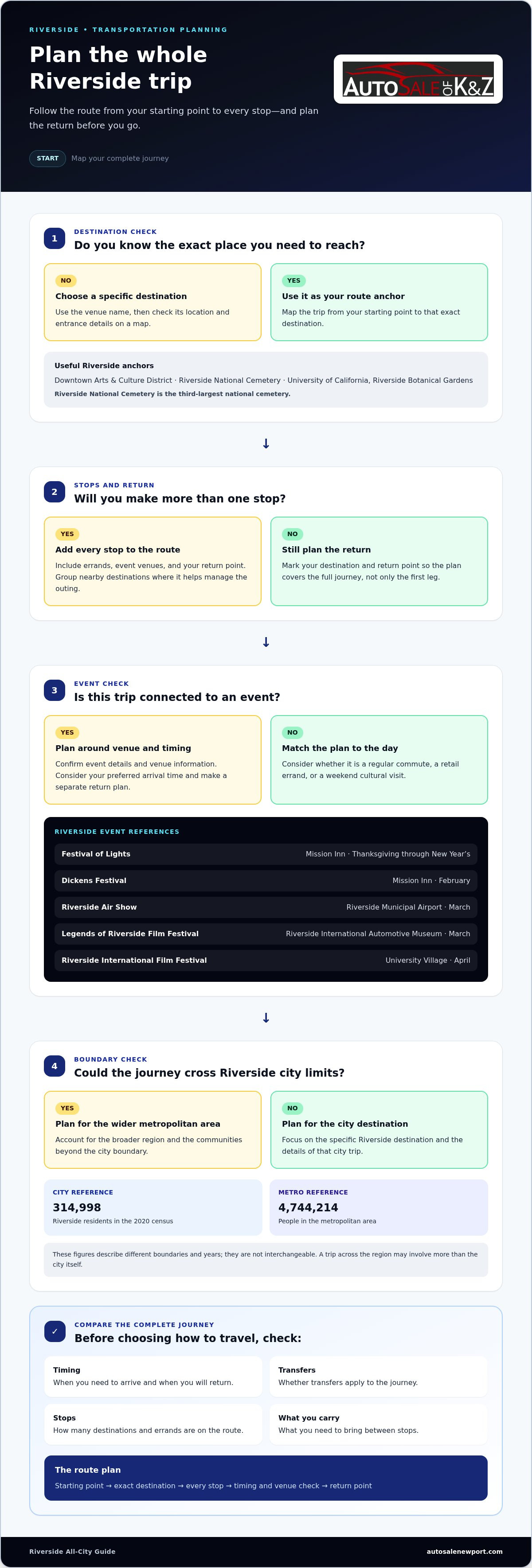
How should you plan travel across Riverside? Start with the places you need to reach, then compare practical options for each trip. A journey to Downtown Riverside’s Arts & Culture District differs from a visit to Riverside National Cemetery or the University of California, Riverside Botanical Gardens. Map each destination from your starting point to see what the day’s travel involves, rather than treating the city as one stop.
Riverside’s metropolitan scale matters because a trip may cross city boundaries. Before leaving, identify your starting point, destination, and return point. Then consider timing, how much you need to carry, and whether you’ll make several stops. Someone visiting a museum and then heading to a retail area has different needs from a commuter travelling to one regular destination. The best option depends on the whole journey, not just its first leg.
Use named destinations to make your plan specific. The city’s Arts & Culture District offers a clear downtown reference point, while the Botanical Gardens provide another destination. Riverside National Cemetery is the third-largest national cemetery, making it another prominent place to include in your travel plan. For each stop, check the location and entrance details on a map, then consider the return trip before setting out.
Events can change what your transportation plan needs to cover. Riverside’s Festival of Lights takes place at the Mission Inn from Thanksgiving through New Year’s. The Dickens Festival is also held at the Mission Inn in February. If you’re travelling to either event, plan around the venue and your preferred arrival time. A separate return plan can help you avoid making last-minute decisions after the event.
Riverside’s calendar includes other named destinations, too. The Riverside Air Show takes place at Riverside Municipal Airport in March. The Legends of Riverside Film Festival is held at the Riverside International Automotive Museum in March, while the Riverside International Film Festival takes place at University Village in April. These examples show why the destination and date belong in your planning notes. Confirm event details and location before deciding how to travel.
For Riverside all-city travel, use this simple sequence to compare options without assuming one mode suits every trip:
- Set the destination. Use the exact venue name, such as the Mission Inn or University Village.
- Add every stop. Include errands, event venues, and the return point in your route plan.
- Compare the full journey. Consider timing, transfers if applicable, carrying needs, and the number of stops.
- Review the day’s details. Check event timing and venue information before departure.
Transportation also affects how you experience Riverside’s diverse culture and history. A downtown visit may focus on the Arts & Culture District, while an event itinerary may connect the Mission Inn with another destination. Riverside has a variety of places to visit, so grouping nearby stops can make an outing easier to manage. Coordinating different destinations and schedules can be challenging, especially when a plan includes both an event and everyday errands.
For recurring trips, note which destinations you visit most often and what each journey requires. A daily commute, a retail errand, and a weekend cultural visit may call for different travel choices. Compare the whole route, not just the distance: stops, timing, what you need to carry, and the return journey all affect what feels practical. This approach gives you a clearer picture of transportation across Riverside and its surrounding metropolitan area.
Riverside california
Riverside sits in Southern California, about 95 km from Los Angeles. Its position also places it between coastal, mountain, and desert destinations. Riverside’s location offers access to coastal, mountain, and desert landscapes. These distances help explain why Riverside can feel connected to several different landscapes. They also make location useful context for understanding the city’s metropolitan character and planning travel beyond its central neighborhoods.
The city’s history gives that setting a local identity. Riverside was incorporated on October 11, 1883, and later chartered on March 5, 1907. Today, its city area covers 81.54 square miles, including 81.23 square miles of land and 0.31 square miles of water. The figures describe the city itself, not the larger region surrounding it. That distinction matters when comparing a destination inside Riverside with one elsewhere in the metropolitan area.
Population figures show the difference in scale. Riverside had 314,998 residents in the 2020 census, while its metropolitan area had 4,744,214 people. The city’s estimated population reached 323,057 in 2025. These figures refer to different boundaries and years, so they shouldn’t be treated as interchangeable. For a Riverside all-city overview, the useful takeaway is that a city visit can form part of a much wider regional routine.
Riverside’s urban area is another way to understand its reach. It had a population of 2,276,703, distinct from both the city and metropolitan-area totals. The city itself had a population density of 3,877.9 people per square mile in 2020. In practical terms, residents, workplaces, services, and destinations are concentrated within a defined municipal area, while the broader metro includes communities beyond it. Knowing which boundary a statistic describes makes local comparisons clearer.
Climate and distance can shape how people organize their days. Riverside averages 300 sunny days per year, while the average July temperature is 35°C. The average January temperature is 18°C. These regional conditions give residents and visitors a reason to consider timing, comfort, and the number of stops in an outing. For instance, someone planning errands and an outdoor visit can group destinations and think about the day’s heat before setting a route.
Use these distinctions to read local information more accurately:
- For a city address, focus on Riverside’s municipal area and the specific destination.
- For regional travel, account for the metropolitan area’s wider population and boundaries.
- For distance planning, distinguish a trip within Riverside from travel toward Los Angeles, the ocean, mountains, or desert.
- For seasonal plans, factor in Riverside’s listed average temperatures and the timing of outdoor stops.
Riverside’s identity is both local and metropolitan. The city has its own boundaries, history, and population, yet its location connects it to a much larger Southern California region. Thinking at both scales helps you interpret distances, population figures, and daily travel without confusing the city with its surrounding metro area. It also gives you a practical starting point for deciding whether a trip stays within Riverside or extends farther across the region.
When planning trips or visiting Auto Sale Newport for your next vehicle, it is essential to consider the broader area rather than assuming every destination falls within city limits. Riverside, California, is 827 feet above sea level. This elevation is another point of geographic context, alongside the city’s position among coastal, mountain, and desert destinations. The ranking figures offer a separate way to place the city: Riverside, California, is ranked 12th among California cities by population, and Riverside ranked as Southern California's 6th largest city. Riverside, California, is ranked 62nd among U.S. cities by population. These rankings describe different comparisons, so each is most useful when read with its geographic scope in mind.
Historical population figures add a longer view of Riverside’s scale. Riverside, California, had a population of 170,591 in 1980, and Riverside, California, had a population of 226,505 in 1990. Those figures provide earlier reference points alongside the more recent totals. Read together, the rankings and historical counts show why a population figure needs its time period and comparison area to be understood clearly. They can help frame a city overview, but they do not replace checking the boundary attached to a particular statistic. For everyday planning, the distinction remains practical: city information describes Riverside itself, while a regional comparison may cover a wider collection of communities. Keeping that difference in view helps make sense of local descriptions without confusing the municipality with the surrounding area.
Auto Sale Newport: Tesla Model 3
Auto Sale Newport offers pre-owned Tesla Model 3 vehicles for drivers considering an electric car for their Riverside-area routine. If your travel includes regular trips across the city or wider region, compare how a Model 3 fits your usual destinations and daily plans. You can also consider a Tesla Model Y, Toyota Prius, or Toyota Corolla if you’re weighing different vehicle options. Think about your typical passengers, stops, and driving needs before narrowing your choice. Auto Sale Newport can also help you explore auto financing or a vehicle trade-in as part of your purchase. For a straightforward next step, contact Auto Sale Newport to discuss the vehicles and options that fit your needs.
Choose a Vehicle That Fits Your Riverside Routine
Your next step is to turn a broad picture of Riverside into a practical decision about your own travel. Consider where you go most often, how regularly your plans extend beyond the city, and what matters in your everyday driving. A Riverside all-city perspective is most useful when it helps you compare vehicles with your real routines, not just a map.
Auto Sale Newport offers pre-owned Tesla Model 3 and Model Y vehicles, along with the Toyota Prius. Consider which model best aligns with your priorities, then weigh your options at a pace that feels comfortable. If financing or a trade-in is part of your purchase, those options can also form part of the conversation.
Gather the questions that matter to you, such as how a vehicle could suit your regular destinations and daily plans. A clear conversation can help you understand the available choices and decide what to explore next. Contact Auto Sale Newport for assistance, and take your next step with confidence.


