

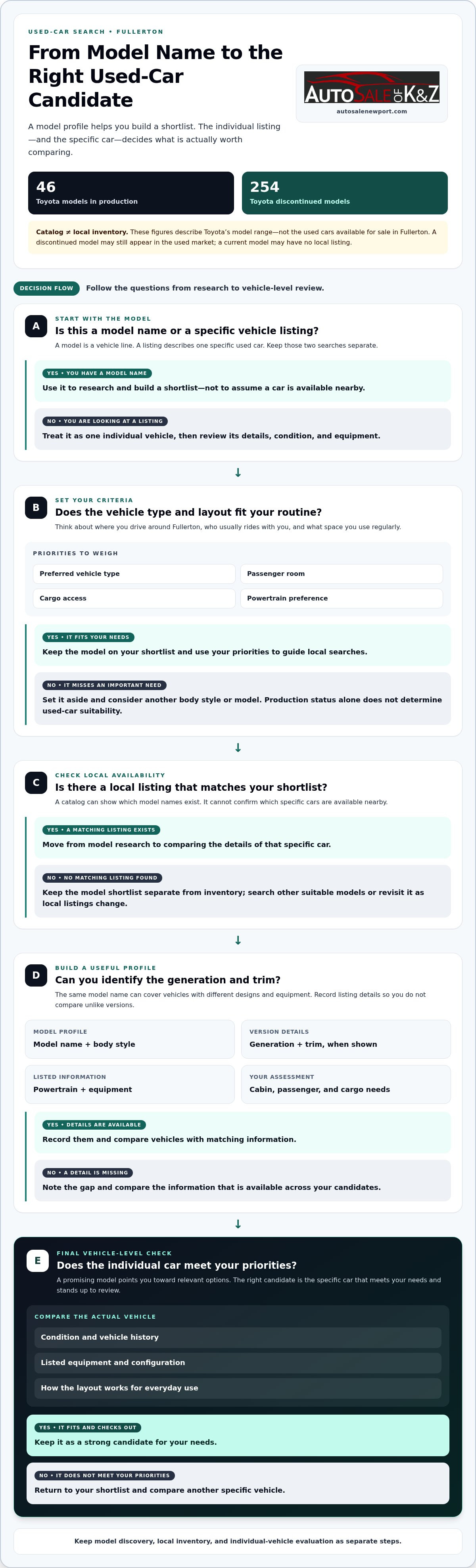
The best place to start is with model profiles, not just familiar badges. Explore all model profiles by separating current names from discontinued ones: Toyota has 46 models in production and 254 discontinued. Those figures describe Toyota’s model range, not the vehicles currently available for sale in Fullerton.
Comparing used cars can feel overwhelming. A model name is a useful starting point, but the right choice also depends on how you drive, what type of vehicle you prefer, and which cars are available locally.
This guide helps you compare used-car options in Fullerton and make sense of unfamiliar names alongside familiar models. Learn how to narrow your search by vehicle type and priorities, what to compare in individual cars, and how local inventory can help you decide which models deserve a closer look.
Key Takeaways
- Use current and discontinued model profiles to understand a name’s place in the lineup before you compare used-car options.
- Build a shortlist around how you drive and the vehicle type you prefer, then compare individual cars on the factors that matter to you.
- Consider familiar choices alongside newer names to broaden your search without losing sight of your priorities.
- Explore Auto Sale Newport’s Tesla Model 3, Tesla Model Y, Toyota Prius, and Toyota Corolla options as you narrow your Fullerton search.
Model discovery
Start your all-model search by distinguishing a model name from an individual vehicle listing. A model is a vehicle line, while a listing describes one specific used car. This matters in Fullerton because a manufacturer’s full catalog includes vehicles that may not be in local inventory. Use model research to build a shortlist, not to assume every version is for sale nearby. Toyota’s catalog, for example, spans current and discontinued models. Its breadth shows why it helps to set clear search criteria.
Toyota has 46 models in production and 254 discontinued models. Those figures describe the manufacturer’s model history, not Fullerton’s available used-car selection. A discontinued model may still appear in the used market, while a current model may have no local listing. First choose the manufacturer, then identify models that match your needs. After that, compare individual vehicles. This sequence keeps catalog research from being mistaken for an inventory check.
To see what to examine on an individual vehicle, watch this practical inspection guide:
Model catalogs can include many generations and configurations. Use the model name as your main search label, then note the generation or trim when a listing identifies it. These details help distinguish vehicles that share a badge but differ in equipment or design. Don’t assume that a familiar model name means every used example is alike. Each car’s condition, history, and equipment matter too.
Start your search with your everyday needs. Consider where you drive around Fullerton, who usually rides with you, and what space you use regularly. A sedan, hatchback, SUV, or electric vehicle may suit a different routine. Write down practical priorities, such as passenger room, cargo access, or powertrain preference. Use them to narrow the model list before browsing individual cars, so your comparisons stay focused.
Next, group model names by how well they fit your routine. Keep promising candidates and set aside those that don’t meet your needs. A discontinued model may still be worth considering if its body style and available used examples suit you. Production status and used-car suitability are separate questions, so don’t let a catalog label make the decision for you.
- Write down your preferred vehicle type and daily-use priorities.
- Search model names separately from individual vehicle listings.
- Record generation or trim details when listings provide them.
- Compare each specific car’s condition and equipment before choosing.
The investigation conducted over 350 total interviews, according to the U.S. Government Publishing Office. That fact offers a reminder to distinguish model discovery from the information gathered about a particular vehicle. A catalog can show which names exist, but it cannot tell you how a specific used car was cared for. Keep the model shortlist and vehicle-level evaluation as separate tasks. Each answers a different question during shopping.
Use your shortlist to guide local searches. Search by model name, then compare listings that match your priorities. Review each car’s details and assess the actual vehicle in person. A promising model can point you toward relevant options, but the right candidate is the individual car that meets your needs and stands up to inspection. Keep that distinction in mind throughout your search.
Model profiles and new faces
A model profile turns a name into a practical comparison. Start with the vehicle’s body style, then note its powertrain and seating layout. Record the generation and trim shown in each listing to distinguish vehicles with the same model name. A newer name may catch your eye, but its profile still needs to suit your routine. Compare the features you’ll use, not just the badge.
Create a simple profile for each candidate with its model name, body style, generation, trim, and listing details. Add questions about cabin space, cargo access, and driving feel. Keep listing facts separate from your own impressions. For example, “listed as a sedan” is a description; “comfortable for my commute” is your assessment. This makes side-by-side comparisons clearer.
An unfamiliar name, newer generation, or unconsidered trim can introduce a new option. Assess each one on its own merits rather than assuming its role from the name. Read the listing details and compare the vehicle’s layout with your needs. If it has a different body style, consider how that affects parking, passenger access, or cargo use. The right fit depends on your priorities.
Generation matters because one model name can cover vehicles with different designs and equipment. Check the generation stated in each listing before comparing features, then review the trim, which can distinguish equipment within a model line. Don’t assume two listings with the same model name have identical features. Recording both details helps you avoid mismatched comparisons.
For each profile, note these details:
- Model name and body style.
- Generation and trim, when shown.
- Powertrain and listed equipment.
- Cabin, passenger, and cargo needs it may meet.
- Questions to resolve during an individual vehicle review.
Compare profiles against one real task at a time. Picture loading groceries, carrying passengers, or parking near home. A sedan and an SUV may suit different routines, but the label alone won’t settle the choice. Check the listed layout and inspect the specific vehicle. Everyday examples make profile details easier to evaluate.
When a model is unfamiliar, break its profile into practical questions: What is the body style? Which generation does the listing describe? What equipment is included? How does the layout work for your regular drives? These questions help you assess a new name without relying on assumptions. If a listing leaves out a detail, compare the information available for all your candidates.
Rank your profiles against your priorities, keeping essential needs separate from preferences, such as a particular cabin layout versus a favored trim. Revisit each listing and compare the actual vehicle’s condition and details. A profile helps organize your choices, but it can’t replace evaluating the individual car. This keeps a new model in the running for practical reasons, not simply because its name is unfamiliar.
Auto Sale Newport: Tesla Model 3
Auto Sale Newport gives Fullerton shoppers a practical next step: compare used-car options that fit the priorities you’ve identified. If the Tesla Model 3 is on your shortlist, consider it alongside the Tesla Model Y, Toyota Prius, and Toyota Corolla. Comparing these choices by body style, powertrain, and everyday use can help you focus on the vehicle profile that suits your routine.
Bring your shortlist and key details, such as passenger space or cargo needs, to Auto Sale Newport in Fullerton. The dealership offers pre-owned cars, trucks, SUVs, hybrids, and electric vehicles, along with trade-in appraisals and financing options. Browse the online inventory or visit the showroom for a test drive. Contact Auto Sale Newport to discuss the models you’re considering.
Make Your Shortlist Work for You
Turn your all-model research into a practical next step: choose which vehicle deserves a closer look based on your daily priorities. A clear shortlist can make the conversation more focused, especially if you’re comparing different types of used cars or replacing your current vehicle. Keep your preferences in view and select a candidate that suits your routine.
Auto Sale Newport offers the Tesla Model 3, Tesla Model Y, and Toyota Prius among its used-car options. If one of those models fits what you’re considering, you can take the next step and discuss your search directly. Contact Auto Sale Newport today to continue exploring your options. A thoughtful choice starts with what matters to you, and you’re ready to move forward at your own pace.
Frequently Asked Questions
What does “all model” mean?
“All model” is a shortened search phrase people may use to look for every vehicle model in a lineup or browse models for sale. In a used-car search, distinguish the model, such as Toyota Corolla, from a specific listing with its own year, trim, condition, and equipment. Treat the phrase as a broad starting point, then narrow your search to models and individual cars that fit your needs.


