

If you think owning an electric vehicle means you can never pick up a wrench again, you might be surprised by what's actually accessible under the hood. Many Fullerton drivers worry that trying to work on Tesla models will immediately void their warranty or lead to a catastrophic software error. It's completely natural to feel a bit intimidated by the high-voltage systems and advanced tech that make these cars so unique. We understand the hesitation, especially when you want to ensure your investment stays valuable for a future trade-in.
This guide will show you that while some tasks definitely require a professional touch, there are several maintenance items you can safely handle in your own driveway. We'll break down exactly which DIY projects are manufacturer-approved, such as cabin filter replacements and tire rotations, and identify the high-stakes repairs that are best left to the experts in nearby Buena Park or Anaheim. You'll learn how to navigate Service Mode and how simple upkeep today can significantly protect your vehicle's resale value here in Orange County.
Key Takeaways
- Distinguish between simple hardware tasks you can handle at home and high-voltage systems that must be left to certified technicians.
- Learn how to safely work on Tesla maintenance items like cabin filters and wiper blades without risking your factory warranty or vehicle safety.
- Identify the specific service needs triggered by Orange County driving conditions, including brake caliper cleaning and A/C system upkeep.
- Protect your future trade-in value by avoiding common DIY mistakes, such as using improper lifting techniques that can damage the battery casing.
- Understand the documentation and maintenance standards that professional appraisers look for when evaluating a pre-owned Model 3 or Model Y.
Can You Work on Your Own Tesla? DIY vs. Professional Service
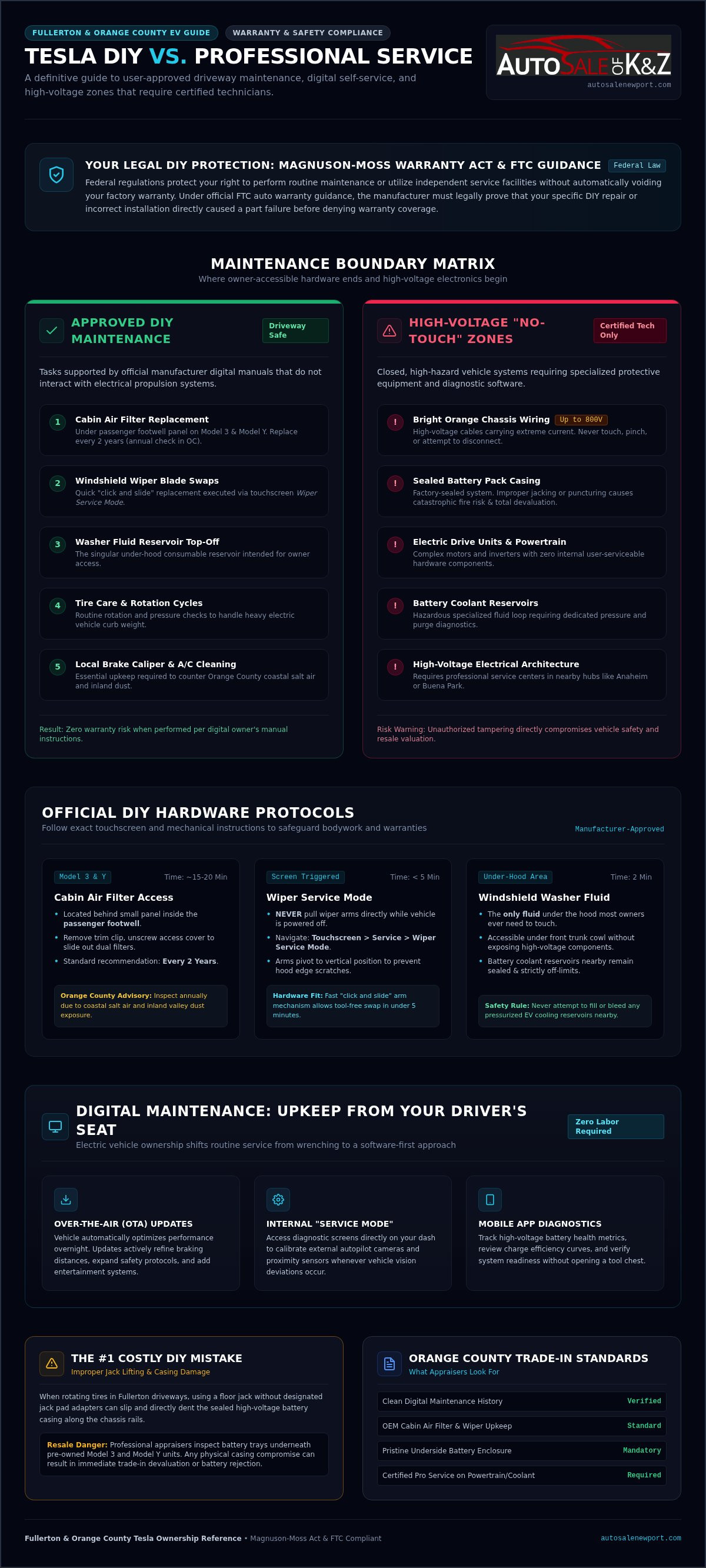
Maintaining a vehicle in Fullerton used to mean scheduled oil changes and checking spark plugs. With an electric vehicle, the philosophy shifts toward a software-first approach. Many local owners want to know if they can still get their hands dirty or if the high-tech nature of these cars makes them off-limits. You can certainly handle several basic tasks yourself, and federal law actually supports this. The Magnuson-Moss Warranty Act protects your right to perform routine maintenance or use independent technicians without automatically losing your warranty coverage. The manufacturer must prove that your specific DIY work caused a failure before denying a claim.
The key is knowing where the user-serviceable parts end and the complex electronics begin. Most routine needs are now managed through the digital owner's manual found right on your touchscreen. Following these official guides is the best way to stay safe and keep your records clean for a future trade-in. If you're eager to see what this looks like in practice, watch this helpful overview of simple maintenance steps:
The "No-Touch" Zones of a Tesla
Safety is the primary reason some areas are restricted. You'll notice bright orange cables throughout the chassis; these signify high-voltage components carrying up to 800V. Never touch or attempt to disconnect these. The battery pack and drive units are sealed, closed systems designed for long-term durability. Attempting to work on Tesla electrical architecture or opening the battery coolant reservoir is hazardous. These tasks require specialized diagnostic tools and protective gear that only professional service centers possess. If a problem involves the powertrain or high-voltage wiring, it's a job for the pros.
Software: The Maintenance Task You Do from Your Seat
In many ways, your car maintains itself while it sits in your driveway. Over-the-Air (OTA) updates handle everything from improving braking distances to adding new entertainment features. You can also use the internal Service Mode to calibrate cameras and sensors if you notice a change in how the car perceives its surroundings. Monitoring battery health metrics is easy through the mobile app. This digital upkeep is just as important as physical repairs, as it ensures your software stays compatible with the latest charging infrastructure and safety protocols.
Approved Maintenance Tasks for Tesla Owners
While the high-voltage powertrain is strictly for professionals, Tesla encourages owners to handle several routine maintenance items. Choosing to work on Tesla hardware for basic upkeep is a great way to stay connected to your vehicle's health while saving a trip to the service center. Federal regulations support your right to do this. The FTC auto warranty guidance confirms that you can perform your own routine maintenance or use independent shops without fear of losing your warranty coverage, provided the work is done correctly.
Air Filter and Wiper Maintenance
Maintaining air quality is vital when you spend time in heavy Southern California traffic. Tesla recommends replacing your cabin air filters every two years. For Model 3 and Model Y owners, this involves removing a small panel in the passenger footwell and unscrewing the filter cover. It is a straightforward task, but it requires a bit of flexibility. Because our local Fullerton environment includes both coastal salt air and inland dust, checking these filters annually is a smart move for your comfort.
When it's time for new wiper blades, don't try to pull the arms away from the glass while the car is off. You must go into the "Service" menu on your touchscreen and select "Wiper Service Mode." This action moves the arms into a vertical position where they can be safely lifted without scratching the edge of the hood. Replacing the blades themselves is a simple "click and slide" process that takes less than five minutes. While you're there, topping off the windshield washer fluid is the only under-hood fluid most owners will ever need to touch.
Tire Care and Rotation for EVs
Electric vehicles are significantly heavier than gas cars and deliver instant torque to the wheels. This combination means your tires will likely wear out faster than you're used to. Regular rotations every 6,250 miles are essential to maximize their lifespan. If you decide to rotate them yourself or take them to a local Fullerton tire shop, you must use rubber "Jack Pads." These small adapters fit into specific points on the chassis to ensure the jack lifts the frame without putting pressure on the battery casing. Crushing the battery frame is a common and expensive mistake for inexperienced DIYers.
Always maintain the recommended tire pressure listed on your driver-side door jamb. Under-inflated tires increase rolling resistance, which directly reduces your range. If you're considering a vehicle that has already been vetted for these maintenance standards, you can browse our current inventory of well-kept models. Using tires specifically designed for EVs is also recommended; these tires feature reinforced sidewalls and specialized rubber compounds to handle the unique weight and performance characteristics of a Tesla.
Common Tesla Issues That Require Professional "Work"
Knowing when to put the tools away is just as important as knowing how to use them. While it's rewarding to handle basics, attempting to work on Tesla thermal systems or high-voltage lines without certification is a significant safety risk. According to the Department of Energy guide to EV maintenance, the specialized nature of electric powertrains means that most mechanical failures require professional intervention to maintain the vehicle's integrity and long-term reliability. Understanding these boundaries helps you protect your car and your safety.
Brake Maintenance in the Age of Regen
Tesla's regenerative braking is a marvel of efficiency. It captures energy to charge the battery while slowing the car, which significantly reduces wear on your physical brake pads. However, this lack of use can lead to a different problem: corrosion. In our coastal Orange County climate, salt air can cause brake calipers to seize if they aren't cleaned and lubricated regularly. Tesla recommends a brake fluid health check every two to four years to test for moisture contamination. If your pedal feels mushy or you hear a grinding sound that doesn't go away after a few firm stops, it's time for a professional flush. Distinguishing between the high-pitched hum of regen and the mechanical squeal of a stuck caliper is a key skill for any owner.
Suspension and Alignment Challenges
The sheer weight of a Model 3 or Model Y battery pack places unique stress on the suspension system. Over time, the upper control arms and bushings can develop a distinct creaking or squeaking sound, particularly when navigating Fullerton’s speed bumps or the occasional pothole. If you notice your car pulling to one side or see uneven tread wear on the inner shoulders of your tires, a professional alignment is necessary. These aren't just comfort issues; a misaligned Tesla consumes more energy and wears through expensive tires much faster. Because these vehicles require specific lift points and software-based steering angle resets, this work is best handled by technicians with EV-specific equipment.
Finally, don't ignore the air conditioning system during our hot Orange County summers. To keep the cabin smelling fresh and the battery cooling loop efficient, the A/C desiccant bag should be replaced every four to six years. For many of these tasks, you don't even need to visit a shop. Tesla Mobile Service can perform many non-safety-critical repairs right in your driveway. However, for suspension replacements or high-voltage diagnostics, a visit to the nearby Buena Park or Anaheim service centers is mandatory to ensure the job is logged correctly in your vehicle's digital history.
How DIY Work Affects Your Tesla Trade-In Value in Fullerton
When you choose to work on Tesla maintenance yourself, you're doing more than just saving a trip to the service center. You're actively managing the future resale value of a high-tech asset. In the competitive Orange County market, a used Tesla Model 3 with a clean, documented history will always command a better price than one with a mysterious past. While routine DIY tasks are encouraged, the way you record that work directly impacts your bottom line during a trade-in appraisal.
Documenting Your DIY Efforts
Transparency is the foundation of a smooth transaction. If you've been handling your own cabin filters or wiper blades, keep every receipt for the parts you've purchased. These physical records prove you've used manufacturer-approved components and followed the recommended intervals. You can also use the "Service" section within the Tesla touchscreen to show a history of software updates and alert clearances. A well-documented DIY history is significantly better than no history at all, as it shows you are a diligent and attentive owner who takes pride in vehicle health.
The Impact of Modifications
It's common for owners in Fullerton to personalize their vehicles with custom wraps, heavy window tints, or aftermarket accessories. While these might make your car stand out on Harbor Boulevard, they often complicate the appraisal process. Most professional buyers and dealerships prioritize vehicles that remain in "stock" condition. If you are looking for the best used car deals in Fullerton, you'll find that the most valuable units are those that haven't been altered with unapproved electrical work or invasive body modifications.
Unapproved modifications can sometimes hide underlying issues or lead to warranty complications that a dealership must account for. To get the highest possible value, it is usually best to keep the vehicle original or at least keep the original parts so the car can be returned to its factory state. This approach ensures your car appeals to the widest range of future buyers, which naturally keeps the demand high.
When you're ready for an upgrade, preparing for an appraisal is simple. We recommend ensuring your software is fully updated and that your cabin is clean. During our on-site appraisals at 1565 W Commonwealth Ave, we focus on objective factors like battery state of health and drive unit integrity. If you'd like to see how your maintenance efforts have paid off, you can request a professional trade-in appraisal to get a clear picture of your car's current market value.
Buying a Vetted Tesla: Why Professional Inspection Matters
Buying a used EV is different from buying a traditional gas car. While you can certainly handle minor maintenance, you don't want to inherit someone else's skipped repairs or unauthorized electrical modifications. When you choose to buy from a dealership that understands Tesla used cars, you're investing in peace of mind. We've already done the heavy lifting of evaluating the car's history and current state, so you can focus on the drive rather than wondering if you'll need to perform complex work on Tesla components yourself.
Our Appraisal Process in Fullerton
How do we ensure every vehicle meets our standards? Our appraisal process at 1565 W Commonwealth Ave is built on technical transparency. We look beyond the paint and upholstery to evaluate the digital and mechanical health of the vehicle. This includes running onboard diagnostics to check for logged high-voltage alerts and listening for specific drive unit frequencies that might indicate early wear. We also verify the battery state of health, as this is the most critical factor in determining long-term value and range. By visiting our showroom, you can see our current inventory of Model 3 and Model Y vehicles that have already passed these rigorous checks.
Trading Up: When It’s Time to Stop Fixing and Start Driving
Is your current Tesla starting to require more frequent professional attention? As these vehicles age, the decision to continue repairs or trade up becomes a matter of logic. Comparing the potential costs of out-of-warranty suspension components or thermal system repairs against the value of a newer model often reveals that trading is the more efficient path. If you are debating between a used Tesla Model 3 vs. Model Y, consider how your lifestyle in Orange County has evolved since your last purchase. A newer Model Y might offer the heat pump efficiency and additional space you need, while a later-model Model 3 could provide a significant range boost over an older unit.
Our goal is to make the transition as simple as possible. We offer auto financing options specifically tailored for pre-owned electric vehicles, helping you secure a competitive rate on your next upgrade. If you're tired of managing a growing list of maintenance tasks, it might be the right time to move into a fresher vehicle. You can Value your trade-in with us today to see how much equity you have in your current car. Let us handle the technical evaluations while you enjoy the benefits of a vetted, reliable Tesla.
Drive with Confidence in Orange County
Understanding the limits of DIY maintenance allows you to care for your vehicle without compromising its sophisticated technology. While tasks like replacing cabin filters and monitoring tire wear are perfectly safe to handle at home; complex high-voltage systems require the precision of a certified technician. This balanced approach keeps your car running smoothly and ensures that your service history remains attractive to future buyers. When you choose to work on Tesla maintenance responsibly, you're protecting one of your most significant investments.
If your current DIY projects are getting more difficult or you're simply ready for a newer Model 3 or Model Y, we invite you to visit us at 1565 W Commonwealth Ave. Our team specializes in evaluating EV health and offers on-site appraisals to help you transition into your next vehicle with ease. You can Browse Our Vetted Used Tesla Inventory in Fullerton today to see our latest selection and explore flexible financing options. We look forward to helping you find the perfect electric vehicle for your Fullerton lifestyle.
Frequently Asked Questions
Can I change the oil in a Tesla?
No, Teslas are fully electric and don't have internal combustion engines, so they don't use engine oil. There is no oil filter to replace or dipstick to check. While there is lubricant in the gearbox, it's a sealed system designed for the life of the vehicle. You'll never need to visit a Fullerton shop for a traditional oil change, which is a major benefit for local owners looking to simplify their routine.
Does working on my own Tesla void the warranty?
Performing routine maintenance yourself doesn't automatically void your warranty. Under the Magnuson-Moss Warranty Act, manufacturers can't deny a claim just because you did the work or used non-OEM parts. However, if your DIY work on Tesla components directly causes a failure, that specific repair won't be covered. It's best to stick to approved tasks like cabin filters and wipers while leaving high-voltage systems to the professionals in Orange County.
What is the most common maintenance "work" a Tesla needs?
The most frequent physical maintenance tasks include replacing cabin air filters and rotating tires every 6,250 miles. Because Teslas are heavy and have high torque, tire wear is the most common ongoing cost for Orange County drivers. You'll also need to refill windshield washer fluid and replace wiper blades periodically. Most other "repairs" are handled automatically through over-the-air software updates while your car is parked at your home in Fullerton.
How often do Tesla brakes need to be serviced in Fullerton?
Tesla recommends a brake fluid test every two years to check for moisture contamination. Even though regenerative braking preserves your pads for over 100,000 miles, the calipers can still seize from lack of use or coastal salt air. A professional check ensures the fluid hasn't absorbed water, which preserves your stopping power. In our mild Fullerton climate, keeping the brake hardware lubricated is essential for long-term safety and performance.
Can I replace the 12V battery in my Tesla myself?
Yes, you can replace the low-voltage battery yourself on older models, but it requires caution. Newer Model 3 and Model Y vehicles produced after late 2021 use a 16V lithium-ion battery that rarely needs replacement. If you have an older version with a lead-acid battery, you'll need to follow the specific power-down sequence in your owner's manual to avoid safety risks or software errors during the swap. Always wear protective gear during this process.
Where can I find a mechanic to work on my Tesla in Orange County?
While Tesla has official service centers in Buena Park and Anaheim, several independent EV specialists have opened across North Orange County. These shops can handle suspension work, alignments, and out-of-warranty repairs. At Auto Sale Newport, we don't provide maintenance services, but we do evaluate these service records carefully during our on-site appraisals at 1565 W Commonwealth Ave. This ensures every car in our inventory is in top condition for its next owner.
How do I check the battery health of a used Tesla before buying?
You can check the estimated range at 100% charge through the car's display or use the hidden Service Mode to run a formal battery health test. This test drains and refills the battery to calculate its remaining capacity compared to when it was new. When we appraise vehicles in Fullerton, we use professional diagnostic tools to verify this data, ensuring that the battery hasn't degraded beyond normal fleet averages of 10% to 15%.
Is it cheaper to maintain a used Tesla than a used Toyota?
Generally, yes. A used Tesla has far fewer moving parts than a used Toyota Prius or Camry, meaning you'll never pay for oil changes, timing belts, or smog checks. While tires for a Tesla might cost more and wear faster due to vehicle weight, the overall lack of mechanical complexity usually results in lower long-term maintenance costs. This efficiency is one reason why used Teslas remain a popular choice for Orange County commuters.


