

The biggest SUV isn’t automatically the best fit for your family. When comparing family SUVs for sale in Buena Park, consider whether a used SUV’s size, condition, mileage, service history, equipment, and price suit your household. The right choice depends on how you’ll use it, not simply how much room it offers.
It’s reasonable to focus on passenger space and everyday convenience when choosing a family vehicle. But those needs are only part of the comparison: a comfortable fit should also make sense for your budget and the way you drive. This guide explains how to weigh mileage and condition, review service history and equipment, compare SUV sizes, and assess price without overlooking the details that matter. You’ll come away with a clearer way to compare used SUVs around Buena Park and decide which trade-offs work for your family. Whether you’re prioritizing room for passengers, useful features, or a manageable price, taking the factors one by one can make the search feel more straightforward.
Key Takeaways
- Compare mileage alongside condition and service history; a single odometer reading can’t tell you the whole story.
- Match an SUV’s size and equipment to your family’s daily routines, passenger needs, and commuting habits.
- Review the asking price in context, weighing the vehicle’s condition, mileage, features, and overall fit.
- Build a recall check into your pre-purchase review, since a used vehicle may have an unrepaired manufacturer recall.
- Compare fuel efficiency by considering how you drive and the type of SUV that fits your needs.
Vehicle mileage, condition, service history, and equipment checks
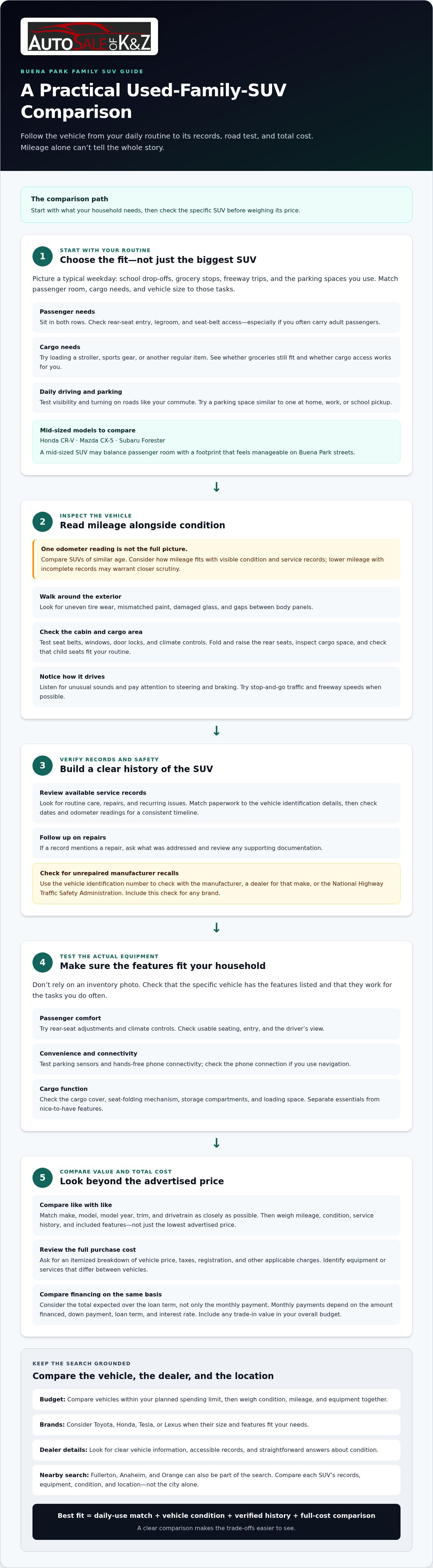
When comparing family SUVs for sale in Buena Park, look beyond the odometer. Mileage provides context, but it doesn’t show how a vehicle was driven, stored, or maintained. Compare SUVs of similar age, and consider mileage alongside visible condition and service records. A lower-mileage SUV with incomplete records may warrant closer scrutiny than one with consistent maintenance history.
Start with a walk-around. Look for uneven tire wear, mismatched paint, damaged glass, and gaps between body panels. Inside, test the seat belts, windows, door locks, and climate controls. Fold and raise the rear seats, inspect the cargo area, and check that child seats fit your routine. During a test drive, listen for unusual sounds and notice how the SUV steers and brakes.
Service history helps show what a vehicle has needed over time. Review available records for routine care, repairs, and recurring issues. Match the paperwork to the vehicle identification details, then check dates and odometer readings for a consistent timeline. If records mention a repair, ask what was addressed and review any supporting documentation. Clear information about condition and available history makes comparisons easier.
Pre-owned vehicles may have unrepaired manufacturer recalls. Before purchase, check the vehicle’s recall status with its manufacturer, a dealer for that make, or the National Highway Traffic Safety Administration. Use the vehicle identification number to search for applicable recall information. Include this step for any brand, whether you’re considering a Toyota RAV4, Honda CR-V, or another family SUV.
Choose equipment that suits your household, rather than relying on an inventory photo. Test features you’ll use, such as rear-seat adjustments, parking sensors, or hands-free phone connectivity. Compare usable seating, storage layout, and the driver’s view. These details can make school runs and grocery trips more comfortable.
- Set a budget: Compare vehicles within your planned spending limit, then weigh condition, mileage, and equipment together.
- Compare brands: Include non-Toyota choices such as Honda, Tesla, or Lexus if their size and features fit.
- Assess the dealer: Look for clear vehicle details, accessible records, and straightforward answers about condition.
Yes. You can include dealerships in nearby Fullerton, Anaheim, and Orange in your search. Compare each SUV’s records, equipment, condition, and location rather than choosing by city alone.
Mid-sized SUVs for commuting and daily driving
A mid-sized SUV can balance passenger room with a footprint that feels manageable on Buena Park streets. Compare models such as the Honda CR-V, Mazda CX-5, and Subaru Forester by the demands of your regular drive. A narrow parking space, crowded school pickup, or tight apartment garage can make visibility and turning feel as important as cabin space. Test the vehicle on roads similar to your commute, not only around a dealership lot.
Consider a typical weekday before choosing. If you make school drop-offs, grocery stops, and freeway trips, check how easily passengers can get into the rear seats. Try loading a stroller or sports gear, then see whether groceries still fit. Families who often carry adult passengers may value rear legroom; those with bulky equipment may prioritize cargo access.
During a test drive, notice how the SUV handles stop-and-go traffic and freeway speeds. Check whether the driver’s seat adjusts comfortably, the mirrors provide useful views, and the controls are easy to reach. Try parking in a space similar to one you use regularly. These checks can show whether a model suits your routine better than a larger or smaller SUV.
Equipment matters when it supports tasks you do often. Compare rear-seat climate controls if children ride along, or test the phone connection if you use navigation. Check that the cargo cover, seat-folding mechanism, and storage compartments work as expected. Compare the actual vehicle’s equipment with its listing, then separate essentials from nice-to-have features.
- For frequent passengers: Sit in both rows and check entry, legroom, and seat-belt access.
- For cargo-heavy routines: Bring a stroller, sports bag, or other regular item to test the loading space.
- For daily parking: Practice a turn and reverse into a space similar to your home or workplace.
Financing affects which models fit your budget. Compare the total you expect to pay over the loan term, not just the monthly payment. Consider the SUV’s condition, equipment, and age, and compare similar vehicles on the same basis. If you have a trade-in, include its value in your overall budget. A consistent comparison keeps the decision focused on daily use, not appearance alone.
Competitive pricing
Judge an asking price against comparable vehicles. Match the make, model, model year, trim, and drivetrain as closely as possible. A Honda CR-V with different equipment may not be a fair comparison. Note mileage, condition, service history, and included features for each SUV. This gives you a clearer picture of value than choosing the lowest advertised price.
Separate the advertised price from the total purchase cost. Ask for an itemized breakdown of the vehicle price, taxes, registration, and any other applicable charges. Compare the full figures, not just headline prices. If one SUV has equipment or services another lacks, identify those differences before deciding whether they matter to your household.
Financing can also change how a deal looks. A monthly payment depends on factors such as the amount financed, down payment, loan term, and interest rate. Compare those terms alongside the vehicle price; a lower payment alone doesn’t show the full borrowing cost. Use the same assumptions when reviewing options, and make sure add-ons haven’t changed the amount financed. The purchase should fit your budget beyond the first payment.
Condition can explain why similar listings have different prices. For example, a Ford Escape with worn tires or incomplete service records may need more attention than a comparable SUV with documented care. Equipment matters, too: a trim with features your family will use may merit a different comparison from a basic trim. Focus on the actual vehicle and its records, not just its original suggested price.
- Match the comparison: Align make, model, trim, drivetrain, and condition.
- Review the total: Add listed charges to the vehicle price before assessing affordability.
- Compare financing: Review the loan term, amount financed, and interest rate together.
- Account for a trade-in: Keep its value separate while comparing the vehicle’s asking price.
A comparison sheet can keep your decision practical. Record each SUV’s asking price, mileage, condition, equipment, and available service history. Add the itemized purchase total and financing terms when available. Comparing two similar SUVs side by side can show whether a price difference reflects equipment, documented condition, or simply a different listing. Use consistent criteria rather than reacting to one number.
Set your priorities before discussing a purchase. If cargo space matters more than a premium audio system, weigh those features accordingly. If a trade-in is part of your plan, assess its value separately, then consider how it affects the amount you’ll finance. A fair comparison accounts for the vehicle, the complete purchase terms, and the features your family will genuinely use.
Used SUVs for sale near Buena Park
Searching beyond Buena Park can give you more options to compare. Include nearby communities such as Fullerton, Anaheim, and Cerritos, then apply the same criteria to each listing. A wider search is useful when it helps you find an SUV that fits your family, budget, and regular driving. Don’t let a longer list replace careful comparisons.
Start by listing what your household needs. Families who regularly carry passengers may prioritize rear-seat access and usable seating. If you bring strollers or sports equipment, check cargo layout and loading height. For a commute with freeway driving and tight parking, visibility, comfort, and maneuverability matter. Write down your must-haves so an appealing listing doesn’t distract from everyday needs.
Compare inventory consistently across locations. Record each SUV’s make, model, model year, mileage, asking price, available service history, and equipment. For example, match the trim and drivetrain when comparing Honda CR-V listings. If a listing omits details, note what you need to clarify during your evaluation rather than assuming the vehicles are equivalent. Listings are a starting point, not a substitute for seeing the SUV.
Plan visits around the vehicles you want to assess. Group listings by city, then confirm the specific vehicle’s location before setting out. At each stop, inspect the cabin and cargo area, test features you’ll use, and take a drive on roads similar to your routine. A Toyota RAV4 and a Ford Escape may both appear suitable online, but seat access, visibility, and storage can feel different in person.
- Compare nearby areas: Search Buena Park, Fullerton, Anaheim, and Cerritos with consistent filters.
- Keep a shortlist: Track each listing’s model, mileage, equipment, records, and asking price.
- Assess the real fit: Test passenger access, cargo use, and driving comfort in person.
- Recheck the listing: Confirm the vehicle’s location and details before planning a visit.
Local inventory varies, so compare the vehicles rather than relying on city names alone. A listing closer to home isn’t automatically the better fit, and a farther option isn’t necessarily worth the trip. Shortlist strong candidates, then weigh condition, equipment, price, and everyday practicality together. For Buena Park-area drivers, the takeaway is to expand the search thoughtfully while keeping the same family-focused standards.
What are the most fuel-efficient family SUVs available near Buena Park?
There isn’t one best SUV for every Buena Park household. Fuel use depends on the exact model year, powertrain, drivetrain, and driving conditions. Compare the fuel-economy figures for each specific vehicle rather than relying on the model name alone. A hybrid and a gasoline version of the same SUV can have different figures, as can different trims. Compare vehicles with similar seating and cargo needs, too, so efficiency isn’t the only measure of fit.
Use the vehicle’s fuel-economy information as a starting point and match it to your routine. If you spend much of the week in stop-and-go traffic, consider city figures; for regular freeway trips, look at highway figures as well. If your driving includes both, compare combined figures across the SUVs you’re considering. Keep model year and drivetrain consistent in your notes to avoid misleading comparisons.
Next, decide whether a hybrid SUV suits your daily use. Hybrid and non-hybrid SUVs can use different powertrains, so compare the listed fuel-economy figures for the specific vehicles. That difference affects how each vehicle uses energy during driving. Compare the listed figures for the exact hybrid and gasoline versions, then consider passenger room, cargo capacity, and equipment. A more efficient option may not be the right family choice if it can’t handle your regular passengers or gear.
- Match the vehicle: Record model year, trim, and drivetrain for every SUV.
- Compare the same measure: Review city, highway, or combined figures consistently.
- Fit the routine: Consider commute patterns, passenger needs, and cargo use together.
- Check the exact listing: Don’t assume another trim or model year shares the same figures.
For example, compare a Toyota RAV4 Hybrid with a gasoline RAV4 only after matching the model years and drivetrain details. Then check whether both provide the space and features your family needs. You can use the same method for other used SUVs near Buena Park, including models from Honda, Ford, or Kia. The useful comparison is between specific vehicles, not broad brand reputations.
Driving style, traffic, road conditions, and vehicle load can affect real-world fuel use. A test drive helps you assess comfort and visibility, but it can’t reproduce every commute. Use listed figures to narrow your choices, then weigh each SUV’s space, condition, and equipment against your family’s priorities. Compare the specific vehicle and its figures, and choose an efficient option that still works for everyday life.
Auto Sale Newport: Tesla Model 3
Auto Sale Newport can help you compare its used-vehicle options after you’ve clarified your family’s space and driving needs. The Tesla Model 3 is a sedan, so it may not fit a household that specifically needs an SUV. If you want an SUV body style, consider the Tesla Model Y or Toyota RAV4 instead. For families open to other body styles, the Toyota Prius, Corolla, and Camry offer additional choices to compare against your priorities.
Use the same checklist from your search: assess seating and cargo needs, review each vehicle’s condition and records, and compare equipment and overall cost. A trade-in can also be part of your purchase planning. Contact Auto Sale Newport to discuss which listed vehicle best fits your family’s needs.
Choose the next vehicle with confidence
Your next step is to turn your comparison into a shortlist based on how your family actually travels. If you’re weighing family SUVs for sale in Buena Park, decide whether an SUV body style is essential or whether another vehicle type could suit your routine. Auto Sale Newport offers the Tesla Model Y alongside the Tesla Model 3 and Toyota Prius, giving you options to consider across different vehicle types. Match your priorities to the vehicle, then focus on the specific details that matter for your household.
A conversation can help you narrow the options and consider whether a trade-in fits your purchase plans. Bring your preferred vehicle type and the needs you’ve identified, such as passenger space or commuting use. There’s no need to rush the decision; a clear next step is simply to discuss the choices that align with your priorities. Contact Auto Sale Newport to talk through your options, and move forward at a pace that feels right for you.
Frequently Asked Questions
Why Choose a Used SUV?
A used SUV lets families compare passenger space, cargo capacity, and features across model years. This can help you prioritize what matters, such as room for a stroller or easier access to the rear seats. Compare the specific vehicle’s condition and equipment, not just its model name. A sedan may suit households that don’t need an SUV’s shape or cargo layout.
Which family SUVs are for sale in Buena Park, CA?
Options to compare for family SUVs for sale in Buena Park include the Toyota RAV4 and Tesla Model Y. Auto Sale Newport offers both models, but vehicles are offered subject to availability. Its dealership is in Fullerton, so include nearby inventory in your search and compare the exact vehicle’s location, model year, seating, and cargo needs. A test drive can help you decide whether the SUV works for your everyday routine.
What used family SUVs are available near Buena Park, and what are their prices?
Vehicles are offered subject to availability, and prices are subject to change without notice; verify details with Auto Sale Newport before purchase. All advertised vehicle prices exclude applicable government fees and taxes, registration fees, finance charges, and any applicable emission testing charges. Compare the complete purchase terms, not just the advertised price.
What should buyers check when inspecting a used SUV in California?
Check the vehicle identification number against its paperwork, test the lights and controls, and look for warning indicators after starting the SUV. Review available service records and check for unrepaired manufacturer recalls through the manufacturer, a dealer for that make, or the National Highway Traffic Safety Administration. During a drive, note unusual sounds, steering response, and braking feel. Customers may arrange an independent third-party inspection before purchase at the customer's expense, subject to dealership and vehicle availability.


