

A used car isn’t automatically outside California’s lemon-law protections. Certain used vehicles may qualify when a defect arose during the original or an extended certified-pre-owned warranty, the car was bought from a retailer, and the manufacturer had a reasonable number of repair attempts. Knowing how to avoid buying a lemon car in Orange County means checking more than the test drive: the vehicle’s history, current recalls, condition, and any lemon-law buyback disclosure all matter.
It’s reasonable to want a dependable car and clear answers before making a major purchase. This guide explains what California’s used-car protections can cover and gives you practical steps for checking a dealership’s credentials, reviewing vehicle records, spotting cabin warning signs, and asking about a buyback history.
Pay particular attention to disclosure paperwork if a car was repurchased under a lemon-law claim. That history doesn’t tell you everything about its current condition, but it is important information to understand before deciding whether to buy.
Key Takeaways
- Some used cars may qualify for California lemon-law protections when the defect and warranty history meet specific conditions.
- Review the vehicle history report, research known model issues, and verify the dealership’s credentials before making a decision.
- Check for open recalls and service bulletins so you can understand reported safety issues and possible repair needs.
- Look for mismatched interior wear, damaged seat belts, and signs of moisture that could point to past damage or neglected care.
- Read buyback disclosures carefully and understand the vehicle’s repair history before deciding whether it’s the right fit.
Do lemon laws apply to used cars?
Sometimes. California protections can apply to certain used vehicles, but the warranty, purchase history, and defect all matter.
For a quick overview of California lemon-law rights, watch this video:
-
Review History and Title Records
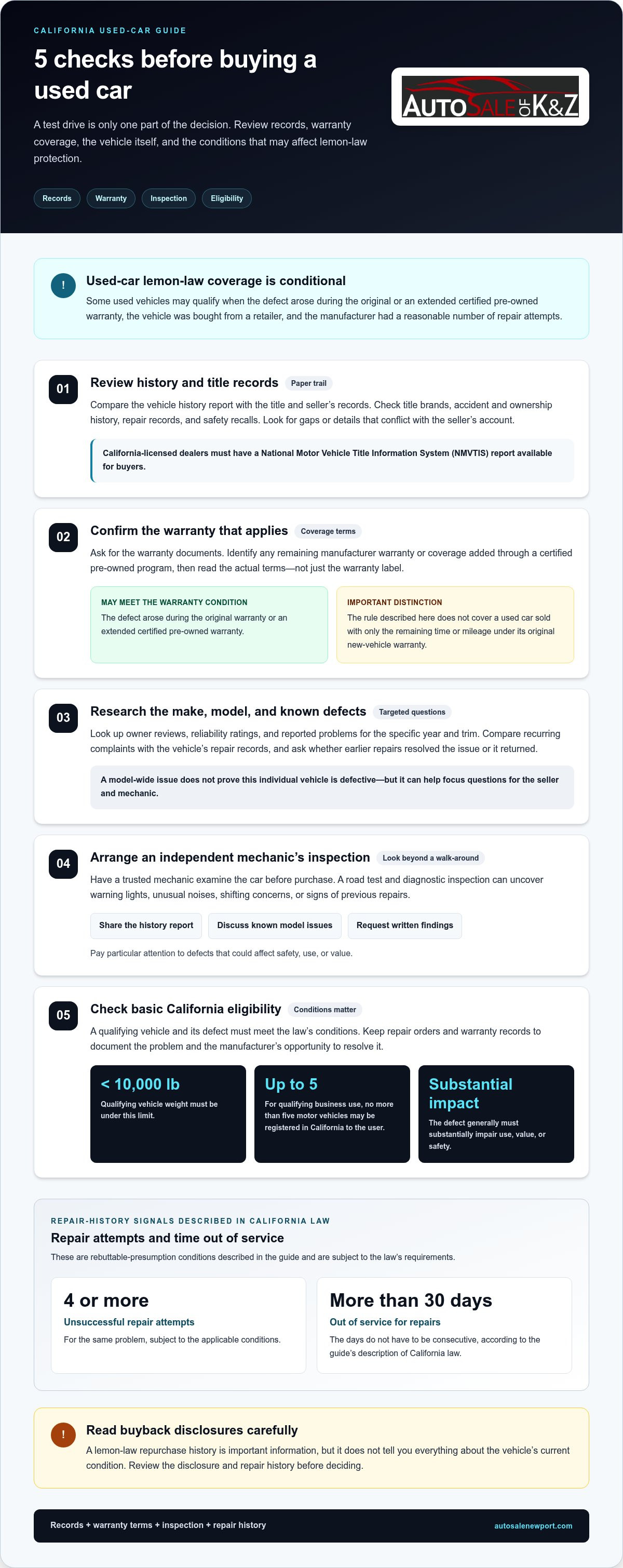
Get the vehicle history report and compare it with the title and seller’s records. Review title brands, accident and ownership history, repair records, and safety recalls. California-licensed dealers must have a National Motor Vehicle Title Information System report available for buyers. Look for gaps or inconsistencies, such as repair entries that don’t match the seller’s account, before committing.
-
Confirm Manufacturer Warranty Coverage
Ask for warranty documents and identify any remaining manufacturer warranty or coverage added through a certified pre-owned program. California’s lemon law can cover certain used vehicles when a defect arose during the original warranty or an extended certified pre-owned warranty, the buyer purchased from a retailer, and the manufacturer had a reasonable number of repair attempts. A used car sold with only the remaining time or mileage under its original new-vehicle warranty isn’t covered under the rule described here. Read the coverage terms, not just the warranty label.
- Research the make, model, and known defects. Look up owner reviews, reliability ratings, and reported problems for the specific year and trim. Compare recurring complaints with the car’s repair records. A model-wide issue doesn’t prove this vehicle is defective, but it gives you focused questions for the seller and mechanic. Check whether earlier repairs resolved the problem or whether it returned.
- Arrange an independent mechanic’s inspection. Have a trusted mechanic examine the vehicle before purchase. A road test and diagnostic inspection can reveal issues a walk-around may miss, including warning lights, unusual noises, shifting concerns, and signs of previous repairs. Share the history report and known model issues with the mechanic, and ask for written findings, especially about defects that could affect safety, use, or value.
- Check basic eligibility before relying on lemon-law protection. Under California’s Song-Beverly Consumer Warranty Act, a qualifying vehicle must weigh under 10,000 pounds. For qualifying business use, no more than five motor vehicles may be registered in California to the person or entity using the vehicle. A defect generally must substantially impair the vehicle’s use, value, or safety. Keep repair orders and warranty records, since the problem and repair history help show whether the manufacturer had a reasonable opportunity to resolve it.
Buying from a reputable licensed California dealership
Choose a licensed California dealer and read the paperwork before signing. Dealer status can affect available records, cancellation options, and potential lemon-law rights.
-
Review Consumer Protections and Lemon Law Options
Check whether the vehicle and its repair history could meet California Lemon Law requirements. A qualifying defect must substantially affect safety, use, or value, and the vehicle generally must have been bought at retail while covered by a manufacturer or certified pre-owned warranty. The law’s rebuttable presumption can apply after four or more unsuccessful repair attempts for the same problem, subject to its conditions.
If a claim qualifies, the manufacturer may have to replace or repurchase the vehicle, pay off its loan or lease balance, and cover incidental damages. Keep repair orders and warranty documents. California law also describes a presumption when repairs keep the vehicle out of service for more than 30 days, even if those days aren’t consecutive, according to the California Legislature.
-
Compare Dealer and Private Seller Purchases
Compare the protections and records available with each type of sale. A used vehicle bought at retail from a dealer may qualify for California Lemon Law coverage when warranty and repair conditions are met; a private sale doesn’t meet the retail-purchase condition. California-licensed dealers must have a National Motor Vehicle Title Information System report available for buyers.
Ask to review the report and purchase documents before committing. Eligible buyers purchasing from a dealer can also choose to purchase a two-day cancellation option, subject to limited exceptions. A private sale doesn’t provide that dealer-specific option, so arrange your inspection and review the records before agreeing to buy.
-
Confirm Warranty and Smog Requirements
Ask which written warranty applies, if any, and read its coverage and exclusions. A dealer sale alone doesn’t establish that the manufacturer’s warranty remains active, and that status matters when assessing potential lemon-law coverage. If a dealer advertises a used car as certified, California requires a complete vehicle inspection and a copy of the inspection report for the buyer.
For smog compliance, a used vehicle brought from out of state must be certified to meet California smog laws to be registered here. Ask to see documentation relevant to registration and check that the vehicle’s status matches the sales paperwork.
- Read the contract and cancellation terms. California dealers can’t add charges to the vehicle purchase contract without full disclosure and your consent. Most used-car buyers from licensed dealers can purchase a two-day cancellation option, subject to limited exceptions. It’s an option to buy, not an automatic cancellation period, so review its terms and decide before signing.
If you’re comparing vehicles, review the used-car options alongside the paperwork and protections described here.
Checking recalls and technical service bulletins
Use the vehicle identification number, or VIN, to check recall status, then compare reported concerns with the car’s condition and service history. A recall check is one part of a thorough pre-purchase review.
- Search recalls and technical service bulletins. Look up the VIN in the National Highway Traffic Safety Administration’s recall information before agreeing to buy. Automakers must provide recall service free of charge, regardless of the vehicle’s age or when the recall was issued. For recall information by phone, NHTSA lists 800-424-9393. Ask for written documentation of completed recall repairs and whether any listed recall remains unresolved.
Also ask whether the manufacturer has issued technical service bulletins for the make and model. A bulletin describes a known concern and recommended service approach; it isn’t the same as a recall. Compare any bulletin with the vehicle’s repair records and note whether the issue appeared during previous ownership.
- Inspect exterior panels for signs of damage. Compare paint color and finish across the doors, fenders, and hood. Mismatched paint or body parts that don’t line up may indicate an accident or poor repairs. Check panel gaps, glass, and visible seams for irregularities. These clues don’t establish the full history, but they give you specific questions to ask and details to compare with the vehicle history report.
- Test-drive the car in varied conditions. Pay attention to steering, braking, handling, unusual sounds, vibrations, and dashboard warning lights. Drive on a bumpy road at about 30 mph to notice suspension behavior. The suspension should rebound softly once or twice after you push down and release each fender; more than two severe rebounds may indicate worn shocks or struts. A family member can take notes while you drive.
- Check fluids after the vehicle is warm. Consumer Reports advises checking transmission fluid after the car has been driven for more than 10 minutes. Follow the owner’s manual’s method, since the procedure can vary by vehicle. Look for fluid that appears unusually dark or smells burnt, and ask about leaks or recent repairs. Have a mechanic interpret signs you can’t confidently identify.
- Compare condition, history, and asking value. Consider the report’s ownership and repair details alongside the car’s visible condition and test-drive results. Uneven tire tread can point to neglected rotations or alignments; recurring repair entries may warrant closer attention. If the written account conflicts with the records, pause and seek clarification before signing. Keep copies of relevant paperwork, especially if you later discuss a dispute with an attorney.
Inspecting the cabin for wear, airbag problems, and flood damage
Inspect the cabin systematically before purchase, then use a professional inspection to investigate concerns that aren’t easy to see.
- Compare cabin wear with the vehicle’s history and condition. Check the driver’s seat, steering wheel, pedals, door handles, and seat belts. Excessive interior wear, such as ripped seats or frayed seat belts, may indicate poor care. Compare the wear with the mileage and maintenance records. A mismatch is a reason to ask about past ownership and repairs, not proof by itself.
- Examine every seat belt and airbag indicator. Pull each belt out fully and look for frayed, cut, or melted fibers. A seat belt with frayed or melted fibers may indicate a previous frontal impact above 15 mph. Check that the airbag indicator responds during startup as described in the owner’s manual. If the indicator stays illuminated or behaves unexpectedly, have a qualified mechanic assess the restraint system before completing the purchase.
- Look for signs of water inside the vehicle. Check the carpet, floor mats, trunk lining, and lower seat areas for dampness, staining, or visible residue. Notice musty odors and inspect exposed metal for unusual corrosion. Check beneath removable mats and around the spare-tire compartment, where moisture can be hidden. One clue alone doesn’t establish flood history, so compare your observations with the vehicle history report and ask about related repairs.
- Inspect the exterior alongside the cabin. Walk around the vehicle in good light and compare the paint, body panels, doors, and windows. Mismatched paint or panels that don’t line up correctly may point to an accident or poor repairs. Compare those observations with the interior condition, title records, and repair entries. A reliable assessment weighs several clues together rather than treating one scratch or worn seat as a complete history.
- Obtain an independent pre-purchase inspection. Ask a trusted mechanic to examine the cabin, restraint system, visible water damage, and mechanical condition. Share your observations and relevant records so the mechanic can focus on the concerns you noticed. If a dealer advertises a used car as certified, California requires a complete vehicle inspection and a copy of its report for the buyer. Review that report carefully; “certified” doesn’t replace your own questions about specific defects.
- Use the findings to guide your decision. Ask for written explanations of repair findings and compare them with any warranty coverage. Lemon-law rules apply only in qualifying situations, and a used vehicle’s warranty and purchase history matter. If the car was previously leased, review its ownership and service records as part of the same careful assessment. Resolve unanswered concerns before signing or arranging payment.
Lemon law buyback disclosures
A lemon-law buyback deserves closer review, not an automatic yes or no. Understand why the manufacturer repurchased the vehicle, what repairs followed, and whether California’s required disclosure appears in the sale materials.
- Look for the required buyback identification. When a California dealer resells a vehicle bought back under lemon law, it must be identified as a lemon-law buyback and have a lemon sticker on its door. Check the door and sales documents before discussing terms. If the identification is missing or inconsistent, pause the transaction and ask for the correct disclosure in writing.
- Ask what defect led to the repurchase. Request the repair history and documentation describing the original problem, the manufacturer’s repair attempts, and the work completed before resale. A buyback label alone doesn’t explain whether the defect was difficult to diagnose, returned after repairs, or was resolved. Compare the explanation with the records and note unanswered questions before signing the contract.
- Compare the disclosure with the vehicle and paperwork. Check the VIN on the vehicle against the sales contract, title documents, and repair records. Compare the odometer reading with the written records, including any mileage entries shown as “000 miles.” Look for differences in dates, mileage, or descriptions of the defect. A mismatch doesn’t establish the cause, but it gives you a specific point to resolve before purchase.
- Evaluate the car’s current condition. Arrange an independent inspection focused on the buyback defect and related systems. For example, if the records describe repeated transmission repairs, ask the mechanic to assess shifting and review the repair documentation. Test-drive the vehicle and compare what you observe with the disclosure. Don’t assume a past refund or repurchase means the car is now problem-free.
- Decide whether the history suits your needs. A disclosed buyback may still involve uncertainty about future reliability, even when repairs have been made. Weigh the documented repair outcome, remaining warranty coverage, current condition, and written terms. If the explanation and records don’t align, or the contract omits information you were shown, hold off and resolve the discrepancy before signing.
If you’d rather consider a vehicle without a disclosed lemon-law buyback history, compare available used-car options before making your decision.
Auto Sale Newport: Tesla Model 3
Auto Sale Newport offers the Tesla Model 3 as a used-car option for Orange County shoppers. If you’re comparing electric vehicles, consider your needs alongside the model’s history, condition, records, and any applicable warranty. A careful review still matters, whether you choose an electric car or a different vehicle.
Other options at Auto Sale Newport include the Tesla Model Y, Toyota Prius, and Toyota Corolla. Compare them based on the space, driving style, and ownership needs that matter to you. Review each vehicle’s paperwork and condition before deciding, and take time to understand the purchase terms.
For a practical next step, contact Auto Sale Newport to discuss your used-car options.
Make Your Next Car Decision With Confidence
Before choosing your next vehicle, write down what matters most for daily driving, from passenger space to fuel or charging preferences. Use that shortlist to compare options and identify which records or questions still need attention. This turns how to avoid buying a lemon car in Orange County into a clear decision process, not a last-minute guess.
If you’re ready to explore your options, Auto Sale Newport offers the Tesla Model 3, Tesla Model Y, and Toyota Prius. Compare these choices against your needs and the information you’ve gathered, then take the next step at a pace that feels right for you.
Contact Auto Sale Newport today to discuss your used-car options. A thoughtful choice starts with the questions you ask, and you’re now better prepared to ask them.
Frequently Asked Questions
What is a car lemon law?
A car lemon law gives consumers legal protections when a vehicle has a serious defect that meets the law’s criteria. In California, protections mainly cover new vehicles and leased vehicles under the manufacturer’s warranty, plus certain used vehicles. A useful starting point for how to avoid buying a lemon car in Orange County is understanding that a used car may qualify when a defect arose during an original or extended certified pre-owned warranty, it was bought at retail, and the manufacturer had a reasonable number of repair attempts.
What should I check during a used car inspection before buying?
Check the paperwork, exterior, cabin, and driving behavior, then have a mechanic assess concerns you can’t evaluate yourself. For example, compare the seats and pedals with the stated mileage, check seat belts for fraying, and look for damp carpet or musty smells. During a test drive, notice warning lights, unusual noises, vibrations, braking, and steering. Write down specific concerns so the mechanic can focus the inspection.
How much does a pre-purchase inspection cost in Orange County, California?
The scope of an inspection affects its cost: a basic review and a detailed diagnostic assessment may differ. Ask what the inspection covers, such as mechanical systems, prior body repairs, or diagnostic checks, so you can compare what is included.
How do I check a used car's history, title, accident records, and odometer in California?
To learn how to avoid buying a lemon car in Orange County, start by obtaining a vehicle history report from a provider approved by the National Motor Vehicle Title Information System. Compare it with the title and sales records, reviewing title brands, accident and ownership history, repairs, and recalls. Match the odometer reading on the vehicle with mileage entries in available documents. Differences between records deserve clarification before purchase, especially when repair dates or ownership details conflict.
How can I verify a California vehicle title and spot a salvage or lemon-law buyback?
Compare the title information and vehicle identification number with the car and sales paperwork, then review the report’s title-brand history. A California dealer reselling a lemon-law buyback must identify it as such and place a lemon sticker on the door. Check the door and contract for matching disclosures. If a title brand, VIN, or buyback disclosure conflicts across documents, pause and resolve the discrepancy before signing.
What are California's used car buyer protections and dealer disclosure requirements?
California-licensed dealers must have a National Motor Vehicle Title Information System report available for buyers, and the Federal Trade Commission requires a Buyer’s Guide on each used vehicle offered for sale. Most used-car buyers from licensed dealers can purchase a two-day cancellation option, subject to limited exceptions. Dealers must disclose added contract charges and get the buyer’s consent. Read the Buyer’s Guide and contract together before signing.
How can I check for open recalls using a car's VIN?
Enter the vehicle identification number into the National Highway Traffic Safety Administration’s recall lookup, or call NHTSA’s recall information line at 800-424-9393. Compare the listed vehicle details with the car you’re considering, then ask whether any recall repairs have been completed. Automakers must provide recall service free of charge, regardless of vehicle age or when the recall was issued. Keep written repair confirmation with your purchase records.
What should I look for during a test drive to spot mechanical problems?
Drive on familiar streets and a bumpy road, and notice how the car responds when braking, turning, and accelerating. Watch for dashboard warning lights, pulling, unusual noises, vibrations, or delayed gear changes. Consumer Reports advises checking transmission fluid after the vehicle has been driven for more than 10 minutes. If a symptom appears, note when it happens and ask a mechanic to assess it before you decide.


