

A used Tesla can deliver advanced electric-car features for less than a new model, but the warranty can make a major difference to the value. For Standard Range Model 3 vehicles, battery and drive unit coverage lasts 8 years or 100,000 miles; for Standard Range Model Y vehicles, it lasts 8 years or 120,000 miles, with a 70% battery-capacity retention threshold during coverage. These details are central to weighing the benefits of buying a used Tesla.
It’s reasonable to look beyond the purchase decision and consider what ownership involves. Battery condition, charging, maintenance costs, software features, and any remaining factory warranty all affect whether a particular car suits your needs.
This guide explains how battery life and warranty coverage vary, what to consider about ongoing costs and software, and where a used Tesla may offer value. You’ll also learn why it matters to check the specific vehicle’s age, mileage, condition, and included features before deciding.
Key Takeaways
- Compare a Tesla’s mileage and battery condition with the remaining battery and drive unit warranty to understand what coverage may still apply.
- Estimate ownership costs beyond routine maintenance, including charging, tires, insurance, and possible repairs.
- Review vehicle history and arrange an electric-vehicle-focused inspection to better understand the car’s condition before purchase.
- Check which Autopilot, Full Self-Driving, and software features are included and active on the specific vehicle.
- Weigh the factory warranty and any used-car coverage alongside the purchase price when deciding whether a particular Tesla offers good value.
1. What Is the Battery Life and Degradation of Used Teslas?
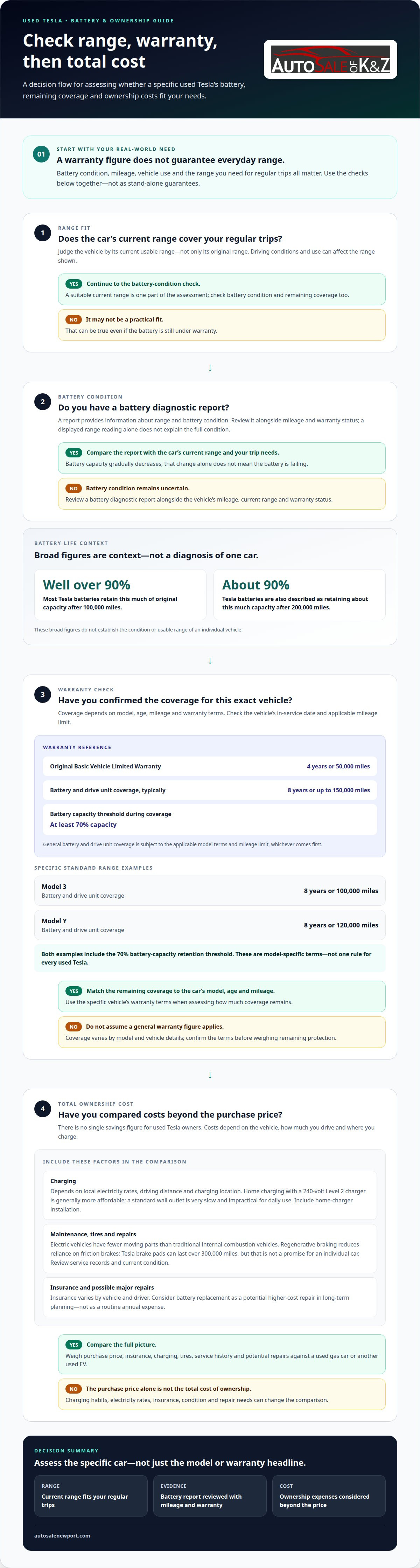
A used Tesla’s battery life depends on its condition, mileage, and how the vehicle was used. Most Tesla batteries retain well over 90% of their original capacity after 100,000 miles. Battery capacity gradually decreases, which can reduce the driving range available on a full charge. That change doesn’t mean the battery is failing. It does mean the car’s current range matters more than its original range when judging whether it suits your daily trips.
Warranty coverage can help frame the risk. Tesla’s original Basic Vehicle Limited Warranty covers the vehicle for 4 years or 50,000 miles. Battery and drive unit coverage typically lasts eight years or up to 150,000 miles, whichever comes first, with exact mileage limits varying by model. During the warranty period, Tesla’s Battery and Drive Unit Limited Warranty guarantees at least 70% battery capacity. Coverage depends on the vehicle’s model, age, mileage, and warranty terms.
For specific examples, the Standard Range Tesla Model 3 battery and drive unit warranty covers 8 years or 100,000 miles. The Standard Range Tesla Model Y coverage runs 8 years or 120,000 miles. Both include a 70% capacity-retention threshold. These are model-specific terms, not a single rule for every used Tesla. Match the vehicle’s model and mileage to its applicable warranty before weighing the remaining coverage.
Battery health and displayed range are related, but they aren’t identical. Driving conditions and vehicle use can affect the range shown, so one reading doesn’t explain the battery’s full condition. A battery diagnostic report provides information about range and condition. Review that alongside the vehicle’s mileage and warranty status. For example, a Model 3 with higher mileage may still have battery coverage remaining, but its exact status depends on its in-service date and mileage limit.
Tesla batteries are also described as retaining about 90% of capacity after 200,000 miles. That broad figure offers context, not a diagnosis of any individual vehicle. Compare a specific car’s reported battery condition with its current range and intended use. If your regular trips require more range than the vehicle currently provides, the car may not be a practical fit, even if its battery remains under warranty.
For 2026, don’t assume a federal used-EV tax credit or state incentive applies automatically. Eligibility depends on the active program’s rules and details such as the vehicle, transaction, and buyer. Battery coverage is separate from tax incentives, so assess each independently. The clearest decision comes from considering the vehicle’s battery health, mileage, remaining warranty, and usable range together, rather than treating one warranty figure as a guarantee of everyday range.
2. How Do Maintenance Costs Compare to New Models?
Maintenance is one part of ownership costs, not the whole picture. That figure doesn’t account for charging, insurance, tires, repairs, or home-charger installation. A used vehicle’s condition and service history also affect what it may need next. Compare each car’s records and current condition rather than assuming every used Tesla will have the same costs.
Electric vehicles have fewer moving parts than traditional internal-combustion vehicles, which can mean fewer maintenance needs. Regenerative braking also reduces reliance on friction brakes, and Tesla brake pads can last over 300,000 miles. That isn’t a schedule or a promise for an individual car. Driving habits, road conditions, and vehicle condition still matter. Review service records for previous repairs, tire replacements, and other work that could affect near-term ownership costs.
Charging costs depend on local electricity rates, how much you drive, and where you charge. Home charging with a 240-volt Level 2 charger is generally the more affordable option. A standard wall outlet can charge a Tesla, but charging is very slow and impractical for daily use. Include home-charger installation in your budget.
How much do used Tesla owners save on fuel and maintenance compared with gas-car owners? There’s no single savings figure. Fuel costs depend on driving distance and local gasoline prices, while electricity costs depend on charging habits and rates. Maintenance and repair needs vary by vehicle condition, so compare your expected charging and service costs with the fuel and maintenance expenses of a gas car.
Purchase price alone doesn’t tell you the total cost of ownership. Compare the used Tesla’s price, insurance, charging, tires, service history, and potential repairs with those of a used gas car or another used EV. Insurance rates vary by vehicle and driver, while home charging may cost less than frequent Supercharger use. The importance of each factor depends on how much you drive and where you charge.
Battery replacement is a major potential repair to include in long-term planning. This is an estimate, not a routine annual expense. Consider it alongside the car’s mileage, service and repair history, and battery condition when assessing the total investment. These details help distinguish everyday maintenance from a less frequent, higher-cost repair.
3. What Are the Key Advantages of Purchasing a Used Tesla?
A used Tesla can cost less to buy than a new model while retaining advanced technology and features. That makes a Model 3 or Model Y worth considering if you want an electric vehicle without paying for a new car. The value depends on the specific vehicle, though. A lower purchase price matters less if accident damage, incomplete records, or needed repairs change the ownership picture.
Start with a vehicle history report, then compare its details with the car itself. Look for reported accidents, damage, ownership changes, and repairs. A history report provides useful context but doesn’t replace an inspection. If it lists repaired damage, compare that entry with the car’s condition and available service records. This gives you a clearer basis for understanding the vehicle’s past.
An electric-vehicle-focused pre-purchase inspection adds another practical check. A mechanic specializing in electric vehicles can assess the car’s overall condition and identify concerns that may affect its use. Arrange an independent third-party inspection at your own expense, subject to dealership and vehicle availability, and consider its findings alongside the history report. For example, if the report shows body repairs, an inspection can help assess the vehicle’s condition today.
During an in-person inspection, look closely at the body, glass, tires, and cabin. Note visible damage or uneven wear that raises questions about previous repairs or current condition. Test the basic controls and observe how the vehicle drives during a test drive. At Auto Sale of K & Z in Fullerton, you can inspect and test-drive a used vehicle before purchase, connecting its paperwork with its actual condition.
Use a simple sequence to keep the decision grounded:
- Read the vehicle history report for reported accidents, damage, and repairs.
- Compare those entries with service records and the vehicle’s visible condition.
- Arrange an inspection by a mechanic who specializes in electric vehicles.
- Test-drive the Tesla and consider whether its condition and features suit your needs.
Each check answers a different question. The history report describes reported events, service records provide maintenance context, and an inspection assesses the vehicle’s present condition. A test drive helps you judge its everyday fit. Together, these steps make for a more considered purchase than relying on appearance or a seller’s description alone.
Buying used may also mean accepting an older model year, so weigh the features you want against the particular car’s condition and records. An extended ownership plan makes a careful inspection especially useful: it helps you understand the car before committing, without treating a lower price as proof of good value. That measured approach can provide more peace of mind than choosing quickly based on the model name alone.
4. Autopilot, Full Self-Driving, and software features
A lower price doesn’t tell you which Autopilot or software features come with a used Tesla. Features vary across models and model years, and earlier vehicles may not include all the Autopilot capabilities available in newer versions. Compare the specific car’s features with what you’ll use for everyday driving, rather than assuming two Teslas have the same equipment.
Which used Tesla models and years are best, and which should buyers avoid? There’s no single model year that suits every buyer, and no year should be avoided solely by date. The Model 3 may suit budget-conscious buyers, while the Model Y can be a family-oriented choice; prioritize the individual vehicle’s condition, history, and included features.
Tesla releases software updates that can enhance performance, add features, and improve the infotainment system. Updates may help a used vehicle retain useful technology, but they don’t make every model equivalent. Earlier models may have different Autopilot capabilities, so consider the features installed on the car itself. A newer software interface alone doesn’t establish that a particular driving feature is included.
Full Self-Driving (FSD) needs special attention because its status can affect how valuable the vehicle is to you. Verify that FSD and other software features are included and active on the specific Tesla before purchase. A feature paid for by a previous owner may not remain with the car, and transfer arrangements can differ. Base your comparison on the vehicle’s current feature status, not a past listing or seller description.
A practical review can follow a few steps:
- Identify the vehicle’s model and model year.
- Review the Autopilot, FSD, and other software features shown for that car.
- Confirm which features are included and active before making a purchase decision.
- Compare the features with your driving needs and the vehicle’s condition.
How much does a used Tesla cost by model, year, mileage, and condition in the United States? There’s no single price across all these factors. Model, model year, mileage, condition, and included software features all affect a vehicle’s value. Compare examples with similar specifications and histories rather than relying on the model name alone.
For example, a Model 3 with the software features you want may be a better match than a higher-priced Tesla with different equipment. Conversely, a Model Y’s space may matter more to a family than an additional software option. A thorough review separates the vehicle’s physical condition from its digital features, helping you judge whether the asking price reflects what that particular Tesla offers.
5. Warranty coverage and Tesla Certified Pre-Owned
Warranty coverage can affect the value of a used Tesla, so consider it alongside model year, mileage, and condition. Some used Teslas may still have original factory warranty coverage. The time and mileage remaining depend on the specific vehicle and its warranty terms. A newer model year alone doesn’t show how much coverage remains; the vehicle’s in-service date and accumulated mileage also matter.
Battery and drive unit coverage is separate from other factory coverage, with model-specific mileage limits. Battery and drive unit warranty limits can vary by vehicle, so check the exact model and version before comparing terms. The Tesla Supplemental Restraint System Limited Warranty lasts 5 years or 60,000 miles. That coverage concerns a different system, not battery or drive unit protection.
“Certified Pre-Owned” sounds reassuring, but the label alone doesn’t tell you which repairs or components a warranty covers. Focus on the written terms: what the warranty includes, when coverage begins, how long it lasts, and whether mileage limits apply. Some used Teslas bought from Tesla are described as including additional warranty coverage of “10k.” That shorthand doesn’t define the coverage’s unit, scope, or start point, so rely on the actual warranty document.
Is it better to buy a used Tesla from Tesla, a dealer, or a private seller? The best fit depends on your priorities: Tesla-sold used cars may include additional warranty coverage, while private sellers may offer lower prices. Dealerships allow buyers to inspect and test-drive used vehicles, helping them assess the car before purchase.
Compare each sale by separating the vehicle’s condition from its warranty protection. A private sale may cost less, but some direct-sale cars are sold as-is. A dealer purchase gives you an opportunity to inspect and test-drive, but that alone doesn’t establish warranty coverage. Evaluate any additional coverage by its written duration, mileage limit, and covered components. Warranty terms are an important factor, not a simple way to rank sellers.
Before deciding, match the vehicle identification and model year to the warranty paperwork, then note any remaining time and mileage limits. Distinguish battery and drive unit coverage from other protections, including the Supplemental Restraint System warranty. This helps you understand what applies to the car you’re considering instead of relying on a broad “certified” description.
If a Tesla Model 3 or Model Y is on your shortlist, compare used Tesla options while weighing each vehicle’s warranty details and condition.
Auto Sale Newport
Auto Sale Newport can help you explore used-car options once you’ve weighed battery condition, ownership costs, software features, and warranty coverage. Its pre-owned selection includes Tesla Model 3 and Model Y vehicles, alongside options such as the Toyota Prius and Corolla if you’re comparing electric and gas-powered driving. Vehicle trade-in services can also fit into your purchase planning.
Consider what matters most in your next car, whether that’s Tesla technology, a particular body style, or comparing different types of vehicles. A focused discussion can help you narrow your choices and decide what to explore further, without losing sight of the factors that affect long-term ownership.
Contact Auto Sale Newport to discuss your used-car options.
Make Your Next Car Decision With Confidence
The benefits of buying a used Tesla matter most when the vehicle fits your everyday priorities, not just your wish list. Before choosing, decide what matters most: electric driving, a particular set of features, or a practical alternative that suits your routine. That gives you a useful starting point for comparing vehicles and deciding what to explore next.
Auto Sale Newport offers Tesla Model 3 and Model Y vehicles, as well as the Toyota Prius, if you’re weighing electric and hybrid options. You can use those choices to focus your search around the kind of driving experience you want, then consider each vehicle on its own merits.
When you’re ready to discuss your options, contact Auto Sale Newport. Take the next step at your own pace and choose the vehicle that feels right for your needs.
Frequently Asked Questions
Buying a Used Tesla a Good Choice?
Yes, a used Tesla can be a good choice if its condition, features, and ownership costs suit your needs. Think about your usual routes, access to charging, and how much range you want in reserve for unexpected trips. For example, a car that handles your weekday commute may not suit frequent longer journeys. The right choice comes from matching the specific vehicle to your routine.
Are Software Updates Important for Used Tesla Vehicles?
Yes, software updates matter because they can enhance performance, add features, and improve the infotainment system. But they don’t make every Tesla’s equipment identical. Before choosing a car, distinguish between features available through software and capabilities supported by that vehicle’s model and equipment. Consider whether its interface and included features meet your needs rather than assuming an older car gains every capability found in newer models.
How Do Maintenance Costs Compare to New Models?
A used Tesla’s maintenance costs depend on its condition and service history, while a new car has no prior ownership record. For a useful comparison, list expected costs over your planned ownership period, including insurance, charging, tires, and repairs. Then compare those with a used gas car’s fuel and maintenance needs. Your driving distance and charging routine affect the result.
What Are the Key Advantages of Purchasing a Used Tesla?
The main advantages are a lower purchase price than a new Tesla and access to electric-vehicle technology and features. A used car also gives you a specific vehicle to assess, rather than a model description alone. For a practical comparison in Fullerton, consider how the car’s features, condition, and charging fit your routine. Reviewing its history and arranging an inspection can turn general appeal into an informed decision.
What Are the Key Takeaways When Considering a Used Tesla?
Make the decision vehicle by vehicle. Compare the car’s current condition, usable range, available features, service history, and remaining warranty terms with your needs and budget. Don’t treat a model name or low purchase price as a complete measure of value. Write down your must-have features first, then assess each vehicle against that list before deciding.
What Is the Battery Life and Degradation of Used Teslas?
Tesla batteries generally lose capacity gradually, so a used car’s available range may differ from its original range. For a specific vehicle, current battery condition is more useful than a broad lifespan estimate. Review its mileage and available battery diagnostic information, then consider your typical daily distance and charging access. This comparison helps show whether the car’s present range fits your routine.
What are the main benefits of buying a used Tesla compared with a new Tesla?
A used Tesla can cost less than a new model while still offering electric driving and technology features. The trade-off is that you need to assess the vehicle’s history, age, and specific features. A new car offers a new-vehicle starting point; with a used car, you can evaluate the actual vehicle before purchase. Compare both options against your priorities, not price alone.
How do Tesla battery and drive-unit warranties transfer to used-car buyers, and how long do they last?
For a used-car buyer, remaining battery and drive-unit coverage depends on the vehicle’s model, mileage, and warranty terms. Standard Range Model 3 coverage is 8 years or 100,000 miles; Standard Range Model Y coverage is 8 years or 120,000 miles, with a 70% capacity-retention threshold. Compare the specific car’s mileage and warranty paperwork to understand its remaining coverage.


