

A car may qualify as a lemon in California when a defect substantially impairs its use, value, or safety. Knowing how to avoid lemons in the LA market starts with looking beyond a seller’s assurances: review the warranty, repair history, incentives, and reputation, and understand that four repair attempts are generally considered reasonable under state lemon laws.
It’s sensible to look beyond a clean appearance and reassuring sales pitch before making a major purchase. A warranty explains which repairs may be covered, while repeated problems or an unclear history deserve careful attention. Neither a discount nor a seller’s reputation tells the whole story.
This guide explains how California lemon-law coverage relates to used cars, what warranties and seller incentives can reveal, and how reputation fits into your assessment. You’ll also learn why repair records matter and what to consider when weighing your options in the Los Angeles market.
Key Takeaways
- Assess a car’s repair history alongside its warranty; repeated unresolved issues can matter more than reassuring sales language.
- California lemon-law coverage focuses on whether a defect substantially impairs the vehicle’s use, value, or safety.
- Seller incentives and information gaps can shape how a used car’s condition is presented, so context matters when evaluating claims.
- Use a seller’s reputation as one part of your assessment, not as a substitute for understanding the vehicle’s history and warranty.
- Explore options such as a Tesla Model 3, Toyota Prius, or Toyota Corolla with Auto Sale Newport as you consider your next used car.
Quality assurances, reputation, and warranties
A warranty describes the seller’s or manufacturer’s repair commitments, while reputation offers context about how concerns are handled. Read both alongside the vehicle’s records, because neither alone establishes its mechanical condition.
Quality Assurances and Reputation
Quality assurances are statements or written terms describing a vehicle’s condition, support, or repair coverage. Reputation reflects how consistently a seller communicates and handles concerns. For buyers, the useful distinction is between a specific commitment and a general impression. A positive reputation may build confidence, but it cannot establish that a particular car has no hidden defect. Compare written assurances with the vehicle’s records and the terms offered for that car.
Service Bulletins and Secret Warranties
A service bulletin is a manufacturer’s notice to repair professionals describing a vehicle issue or recommended service procedure. It isn’t automatically a recall or a promise of free repairs. “Secret warranty” is an informal phrase for manufacturer assistance or extended coverage that may address a known problem beyond ordinary warranty terms. Ask whether a bulletin or special coverage applies to the vehicle, and get any repair commitment in writing. A bulletin can flag a recurring concern, but it doesn’t by itself prove that a specific car is defective.
Express and Implied Warranties
An express warranty is a stated promise about covered repairs or vehicle condition; its written terms define the scope and limits. An implied warranty arises from the transaction rather than a specific written promise. Article 2 of the Uniform Commercial Code provides guidelines for express warranties and defines many implied warranties covered by lemon laws. The precise terms matter: note who provides coverage, which defects are covered, how long it lasts, and what exclusions apply.
For example, a written promise to repair a named component differs from a broad claim that a car is dependable. Keep the purchase documents and warranty together, then compare a repair concern with the coverage terms. This makes it easier to distinguish a specific commitment from sales language and identify which warranty may apply.
Magnuson-Moss Warranty Act
The Magnuson-Moss Warranty Act is a federal law concerning warranties on consumer products. Section 103, 15 U.S.C. 2303, applies to consumer products actually costing the consumer more than $10, excluding tax, according to the Federal Trade Commission. The Act does not make every used car problem a warranty claim. The vehicle’s written coverage and the kind of promise made remain important when assessing a dispute.
Use the warranty paperwork as a practical record, not just a closing document. Match the named warrantor and covered parts to any repair orders, and keep written responses about requested repairs. A consistent paper trail can clarify whether a seller or manufacturer made a specific assurance and how it relates to the vehicle’s condition.
California lemon-law coverage
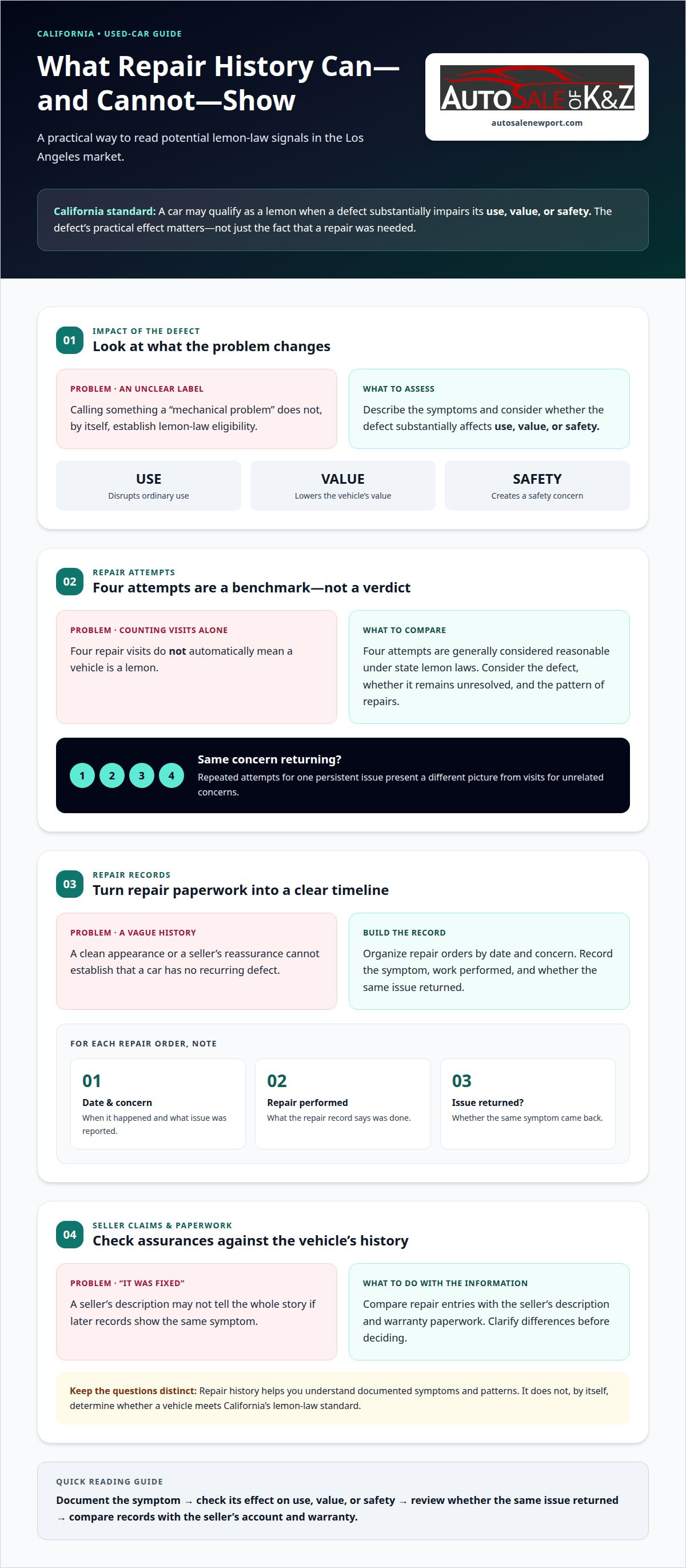
In California, a car may qualify as a lemon when a defect substantially impairs its use, value, or safety. Knowing how to avoid lemons in the LA market also means understanding that the standard considers the defect’s practical effect, not simply whether a repair was needed. A malfunction that repeatedly prevents normal driving may matter more than a minor inconvenience. For example, a recurring failure that affects safe operation differs from an isolated cosmetic flaw.
Repair attempts matter, too. Four attempts are generally considered reasonable under state lemon laws, but that benchmark doesn’t mean every vehicle with four repair visits is automatically a lemon. The nature of the defect and whether it remains unresolved are important context. A car with repeated visits for the same persistent issue presents a different picture from one visit for each unrelated concern. Treat the repair count as one factor, not a stand-alone verdict.
Mechanical problems can be relevant to lemon-law coverage in California, but the word “mechanical” alone doesn’t establish eligibility. The connection between the defect and the vehicle’s use, value, or safety remains central. A malfunction that disrupts ordinary use, lowers the car’s value, or creates a safety concern may deserve closer attention. A feature that works imperfectly but doesn’t substantially affect those areas may raise a different question. Describe the actual symptoms rather than relying on a broad label.
To understand a vehicle’s history, organize repair orders by date and concern. Note the reported symptom, the repair performed, and whether the same issue returned. This record helps distinguish repeated attempts to address one defect from unrelated maintenance. Compare the entries with the seller’s description and warranty paperwork. If the seller says a problem was fixed but later records show the same symptom, clarify the difference before deciding.
A practical approach to how to avoid lemons in the LA market is to keep the legal test separate from your buying decision. A vehicle can have a serious repair history without a buyer being able to determine from that history alone whether it meets California’s lemon-law standard. Likewise, a clean-looking car doesn’t establish that it has no recurring defect. Focus on documented symptoms, their effect, and the repair pattern. If you’re still weighing your next vehicle, explore used-car choices as part of your decision.
Mechanical problems may be relevant to lemon-law coverage, but eligibility depends on the particular defect and its effect. That point is a reason to describe a concern precisely rather than dismissing it as ordinary or using a broad label that leaves its effect unclear. Keep the account focused on what happened, what was repaired, and whether the symptom returned. Relate each concern to the car’s use, value, or safety, and preserve supporting paperwork. Mechanical coverage is useful context, but it does not replace careful attention to the particular problem and its documented history when assessing a vehicle.
Seller incentives to misrepresent vehicle quality
A used-car seller has a financial reason to present a vehicle attractively and complete a sale. That incentive doesn’t prove dishonesty, but it does mean promotional language deserves comparison with specific records. For example, “runs well” describes an impression, while a repair order identifies a reported symptom and completed work. Buyers get a clearer picture by separating observable condition from claims about the car’s history.
Information can be uneven. A seller who has driven a car for months may know about a recurring vibration that a buyer hasn’t experienced during a brief viewing. A clean interior or fresh paint can make a vehicle look appealing, but neither explains why a warning light appeared last week. Compare the sales description with service records, warning indicators, and the seller’s account of known issues. Ask for clear explanations when details differ.
Some incentives are ordinary rather than deceptive. A seller may want to avoid delays, emphasize recent work, or focus on features that make a car appealing. For instance, a new set of tires may be worth mentioning, but it doesn’t answer whether the transmission has slipped or the air conditioning has failed. Consider each positive detail in context. One recent repair cannot establish the condition of unrelated systems.
Pressure can also shape what gets discussed. If the conversation stays focused on a monthly payment, color, or a limited-time offer, the vehicle’s condition may receive less attention. Bring the discussion back to concrete questions: What symptoms were reported? Which repairs were completed? Did the same concern return? A useful answer connects the issue to the car instead of relying only on broad phrases such as “fully checked” or “good as new.”
Written details help distinguish a specific assurance from a sales impression. If the seller says a brake concern was repaired, ask for the matching work record and compare its date and description with the claim. If a component was recently replaced, check whether the paperwork identifies the part and work performed. These examples don’t prove a hidden defect, but they make inconsistencies easier to spot and discuss.
Use a simple, evidence-based approach. Match each important claim to a record, a visible feature, or a clear explanation. Treat missing context as a reason to pause and reassess the information, not as proof of fraud. A seller’s incentive to close a deal and a vehicle’s actual condition are separate questions. Keeping them separate helps you judge the car on its evidence rather than on enthusiasm, discounts, or confident assurances.
Adverse selection and market collapse
Adverse selection occurs when one side knows more about a product than the other. In a used-car sale, an owner may understand a vehicle’s history better than a prospective buyer. George Akerlof explored this information problem in a 1970 paper. The idea helps explain why uncertainty can affect the whole market, not just one purchase.
Imagine buyers couldn’t distinguish reliable cars from problem cars before purchase. They might offer a price that reflects their uncertainty rather than a particular vehicle’s true condition. An owner with a well-maintained car may decide that offer doesn’t reflect its value. Owners of cars with hidden problems may be more willing to accept it. As a result, the available choices can tilt toward lower-quality vehicles.
This is the adverse-selection cycle: uncertainty affects what buyers will pay, and that price can influence which sellers stay. If more owners of dependable cars leave, buyers have even less reason to trust the remaining selection. They may lower their offers further or leave the market. A market collapse in this explanation doesn’t require every car to be defective; it can begin when buyers can’t reliably distinguish quality.
For an individual buyer, the practical lesson is to look for information that reduces uncertainty. Consider two similar cars with different levels of documentation. One has a consistent ownership account and records that support the seller’s description. The other has gaps that make its history difficult to understand. These examples don’t establish either car’s condition, but they show why credible details can affect a buyer’s confidence and willingness to proceed.
Clear signals help distinguish a well-supported claim from a general sales pitch. A specific explanation tied to a record gives buyers more to assess than a broad statement such as “excellent condition.” Reputation can also shape expectations, but it isn’t proof about a particular vehicle. The strongest picture comes from several consistent details, not a single reassuring claim or attractive offer.
Akerlof’s analysis of asymmetric information later formed part of work recognized by the Nobel Memorial Prize in Economic Sciences. Akerlof, Michael Spence, and Joseph Stiglitz jointly received the prize in 2001 for research on asymmetric information. Applied to used cars, the concept shows why transparent information supports trust: buyers can make more informed distinctions, and sellers of reliable vehicles have a stronger way to demonstrate their value.
A 1962 Volkswagen Beetle print advertisement used the slang term “lemon” in a self-deprecating manner. That choice turns a label for an undesirable car into part of the seller’s own message, rather than leaving buyers to discover a problem after purchase. It offers a useful contrast with hidden information: acknowledging the possibility of flaws can make a claim feel more candid, though the word itself cannot establish a vehicle’s condition. A candid description may invite scrutiny; it does not replace records or other evidence when assessing an individual car.
Asymmetric information in used-car sales
Asymmetric information means one party knows more about a transaction than the other. In a used-car sale, the current owner may know how the car behaves across different trips and conditions. A buyer usually sees only a short snapshot. For example, a dashboard that looks normal in a driveway says little about how the vehicle performs after extended driving. The gap between private experience and visible evidence shapes the buyer’s decision.
Some vehicle qualities are easy to observe; others emerge only through use. Paint color, tire condition, and interior wear are visible during a viewing. Intermittent electrical faults or a noise that appears only after driving may be harder to identify. A seller’s description can add context, but it remains one source of information. Match the account to available records and the vehicle’s behavior instead of treating appearance as a complete history.
Documents help narrow the information gap. A dated service record can show what concern was reported and what work followed. A sequence of records may reveal whether a repair resolved the stated issue or whether the same concern returned. Missing details don’t establish that a car has a defect. They do make it harder to connect a seller’s claim with a documented event, so keep each conclusion tied to the evidence available.
Questions are most useful when they invite specific answers. Ask what prompted a repair, what changed afterward, and whether the symptom returned. If a record names a replaced part, ask how it relates to the concern described. For example, an invoice for a battery replacement explains that work, but not every later electrical symptom. Separating a documented repair from broader claims helps prevent one fact from carrying more weight than it deserves.
Consistency across sources is another useful signal. Compare the seller’s account, service paperwork, warranty terms, and the car’s current behavior. If the paperwork describes a concern that the sales description omits, ask how the two fit together. An explanation that matches the documents adds context. A mismatch may have a simple explanation, but resolving it helps you assess the information rather than assume a motive.
George Akerlof’s analysis of information gaps helps explain the transaction, but it isn’t a reason to label every seller or vehicle. The practical response is to reduce uncertainty through evidence: identify what you can observe, connect statements to records, and note what remains unexplained. This approach won’t tell you everything about a car’s future. It does ground your decision in its known history rather than a brief impression or unsupported claim.
Auto Sale Newport
Auto Sale Newport offers used-car options for readers applying these checks to their next purchase. Its selection includes the Tesla Model 3, Tesla Model Y, Toyota Prius, and Toyota Corolla. As you consider a vehicle, use the same careful approach: weigh its condition, documentation, warranty terms, and the seller’s answers together rather than relying on one reassuring detail.
If you’re replacing a car, Auto Sale Newport offers vehicle trade-ins and on-site appraisals to help with your purchase plans. Use what you’ve learned to evaluate your next vehicle and choose one that suits your needs.
Contact Auto Sale Newport to discuss your used-car options.
Make Your Next Car Decision With Confidence
A used-car purchase is also a decision about what you value: predictable ownership, a certain driving experience, or room for changing needs. Before settling on a vehicle, consider which qualities matter most to your routine, then use those priorities to guide your final choice. A clear reason for choosing a car can keep persuasive sales language from taking the lead.
Knowing how to avoid lemons in the LA market means making room for questions before you commit, not rushing to a decision because an offer feels appealing. If you’re ready to consider your next used car, Auto Sale Newport can help you explore your options. Contact Auto Sale Newport to discuss your next car, and take the next step at a pace that feels right for you.
Frequently Asked Questions
Is My Car a Lemon?
Your car may qualify as a lemon in California if a defect substantially impairs its use, value, or safety. Four repair attempts are generally considered reasonable under state lemon laws, but that number alone doesn’t decide the issue. For example, repeated power loss that affects safe driving differs from a minor, isolated annoyance. Gather repair records and note how the defect affects everyday use; those details help clarify the situation.


