

A free online estimate can give you a useful starting point, but it may not match a dealer’s offer. To estimate your car’s value online for free, enter details such as the vehicle’s year, make, model, mileage, condition, options, and accident history. The result may also reflect prices for similar vehicles in your area. Accident damage can lower value, depending on the extent of the damage and the vehicle’s current condition.
It’s natural to want one clear number, especially when deciding whether to trade in or sell privately. An estimate is a guide, while a dealer’s offer also reflects resale prospects, local demand, inventory, and reconditioning needs. Understanding what trade-in and private-party estimates represent, how accident history can affect value, and why figures differ can help you compare your options more clearly.
Key Takeaways
- Use your car’s year, trim, mileage, condition, options, and accident history to understand what shapes its estimated value.
- Compare trade-in and private-party estimates as different sale paths, not interchangeable prices.
- Learn why accident history, local demand, and the vehicle’s condition can shift an appraisal.
- See how vehicle details, including a VIN, can help a professional assess your car more accurately.
- Understand why a dealer’s offer may differ from an online estimate and what the offer reflects.
What Is the Trade-In Value?
A trade-in value is the amount a dealer offers for your vehicle when you apply it toward another car from that dealer. It differs from a private-sale price because the dealer assesses the vehicle for resale, including its condition, local demand, and likely reconditioning needs. For example, pre-owned dealerships such as Any Credit Auto Sales LLC evaluate trade-ins based on local inventory requirements and the retail demand for reliable used cars.
Factors Behind Vehicle Values
A professional estimate considers the vehicle’s age, mileage, condition, options, accident history, and prices for similar vehicles in your area. These details work together: high mileage can reduce value, while visible damage may mean reconditioning costs. A newer vehicle with fewer miles may be valued differently from an older example of the same model.
Optional equipment and packages may add little or no resale value, even if they increased the original purchase price. Depreciation also varies with the economy, vehicle type, brand, model demand, and gas prices. An estimate therefore reflects both the specific car and the market for comparable vehicles nearby.
Details for an Estimate
Provide the vehicle’s year, make, model, trim, mileage, condition, and options. Trim matters because versions of the same model can have different equipment. Mileage and condition help distinguish otherwise similar cars, while options clarify how the vehicle compares with local listings.
A VIN can help identify the vehicle’s specific year, make, model, and configuration during a lookup. Since one model name may cover several trims, the VIN can help narrow the match. Some valuation processes also use a license plate as an identifier, but accurate mileage and condition details remain important.
For example, a Toyota Corolla with higher mileage and body damage should not be assessed like a lower-mileage Corolla in better condition. A dealer also considers local prices for similar vehicles, rather than relying on the model name alone.
Value Update Frequency
Vehicle values can change as local supply and demand, model popularity, and broader economic conditions shift. There is no single update schedule for every estimate. An online figure reflects the data available when it is generated, while a later appraisal may account for changed market conditions or a more complete assessment of the vehicle.
Refresh the estimate when an important detail changes, such as mileage, condition, or accident history. If time has passed, revisit it before a planned sale, especially if comparable vehicles in your area are priced differently. A current estimate gives you a more relevant starting point for a trade-in discussion.
Free trade-in and private-party value estimates
A free online estimate may show separate trade-in and private-party figures because each represents a different way to sell. A trade-in estimate is generally closer to auction wholesale value, while a private-party transaction price falls between wholesale and retail value. Treat each figure as a guide for its sale route, not as a guaranteed offer or final transaction price.
A dealer considers what the vehicle could bring through resale and what it may cost to acquire and prepare. Auction and transportation fees, for example, can affect the amount a dealer is willing to offer. Auction wholesale value helps frame the calculation, but a dealer may offer more when the vehicle fits its inventory needs.
A private-party estimate reflects what an individual buyer might pay based on demand and the vehicle’s condition. A well-kept car that appeals to local buyers may attract more interest than one needing substantial reconditioning. Still, an estimate cannot account for every buyer’s priorities or the outcome of negotiations, so a private-sale price may differ from the displayed figure.
Choosing between a trade-in and a private sale involves more than comparing two figures. A private sale can bring more money, but may take more time and involve meeting strangers and watching for potential scams. Private-party sales typically do not offer buyer financing, a warranty, or recourse if problems arise; they are generally final and as-is. A trade-in can be a more direct option when buying another vehicle from a dealer.
Use the estimates to compare the likely value with the effort and process involved. A car-buying service may be quicker and safer than arranging a private sale, but generally pays less than a private buyer. For sellers looking for a middle ground, specialized intermediation services like auto-services.be manage used-car sales via mandates to combine private-party pricing with professional handling. Comparing offers from multiple used-car lots can help show the high and low ends of the vehicle’s potential value. Keep the comparison focused on the same car and condition.
- Trade-in: Compare the dealer’s offer with an auction-wholesale-oriented estimate.
- Private party: Consider the potential for a higher sale price alongside the time and buyer interactions involved.
- Dealer offers: Compare offers from used-car lots to understand the range available for your vehicle.
If a trade-in estimate is lower than a private-party estimate, the difference may reflect resale costs and the work involved in a private transaction. Decide which route better fits your priorities: a more direct dealer transaction or the possibility of a higher private-sale amount with additional effort. Comparing both gives you a clearer basis for your next step.
How does an accident affect a car's value?
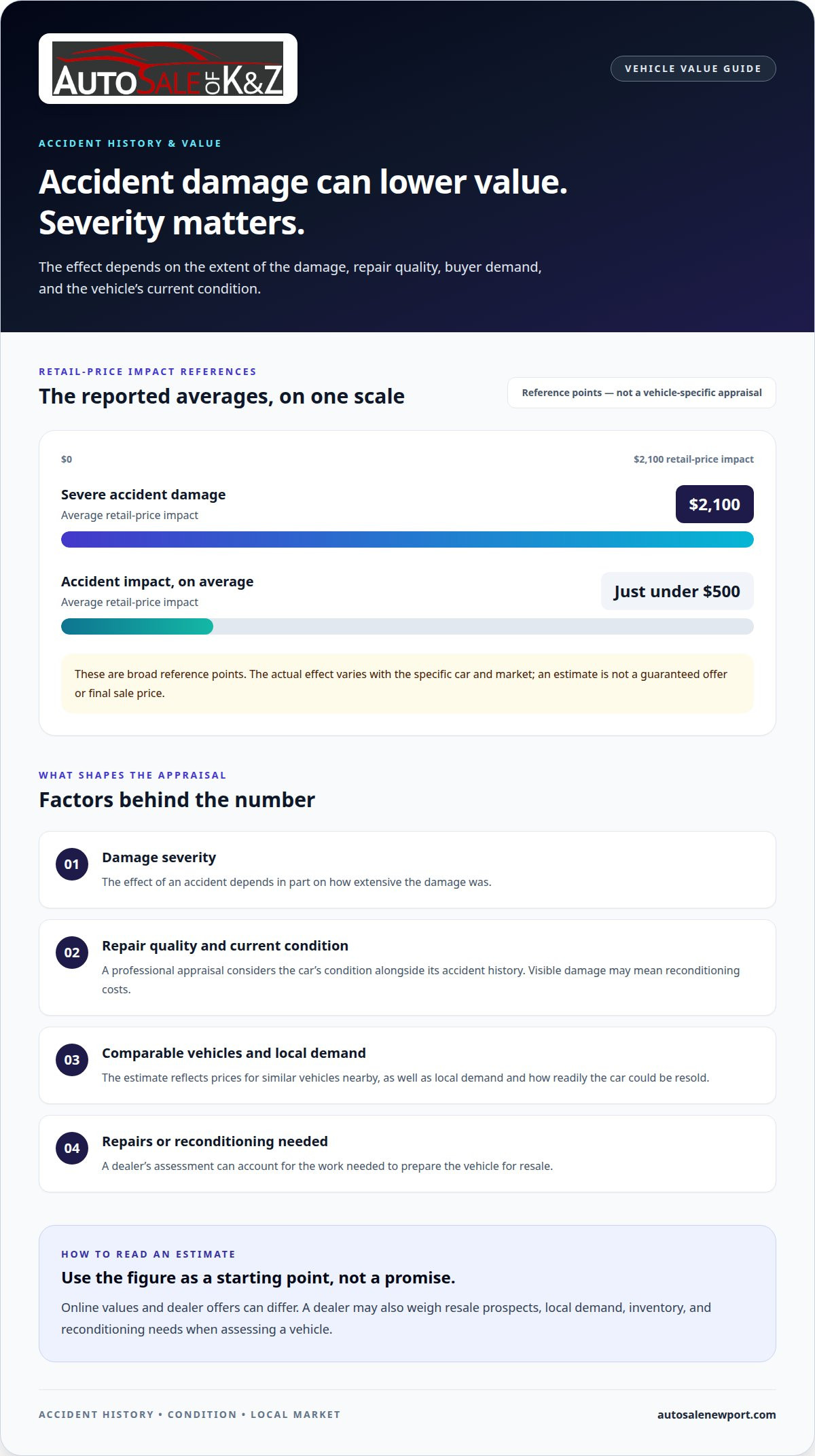
An accident can lower what a car is worth, but the effect depends on damage severity, repair quality, and buyer demand. The average impact of an accident on a vehicle’s retail price is just under $500, while severe accident damage has an average retail-price impact of $2,100. These figures are broad reference points, not a substitute for assessing the specific vehicle.
A dealer estimates current market value by considering the car’s condition and accident history alongside comparable vehicles and local demand. The appraisal also considers how readily the vehicle could be resold and what repairs or reconditioning may be needed. A repaired car with documented work may be assessed differently from one with visible damage or unresolved problems.
To check prices for similar used cars nearby, a dealer compares vehicles with similar makes, models, years, mileage, and condition in the same market. Local inventory and demand matter because comparable vehicles can sell for different amounts across regions and ZIP codes.
Location can affect value beyond the prices of nearby listings. Consumer preferences vary by region, influencing demand for different vehicle types. For example, rear-wheel-drive pickup trucks are generally worth more in the Southeast than in the Northeast. A dealer considers this local context when estimating resale value rather than relying on a nationwide figure alone.
Timing can also influence a selling decision. Local supply, buyer demand, and dealer inventory may change, shifting the market for a particular vehicle. Seasonality can affect which types of cars attract attention, but its impact depends on the vehicle and local conditions. A practical estimate weighs current comparable vehicles and local demand together.
Collector cars can follow distinct market patterns. Their value depends on demand for the specific model and condition, not simply age. For example, the displayed annual change for a 1967 Maserati Mexico Coupe in #3 Good Condition is -6.8% in October 2026. That example shows why a broad assumption about classic-car appreciation may not fit a particular model.
For an accident appraisal, the dealer considers the vehicle’s damage history alongside its present condition and resale prospects. Minor repairs and severe structural damage can lead to different assessments. The estimate may also vary by location because regional supply and demand shape likely market prices. Share accurate accident details and describe repairs clearly so the appraisal reflects the vehicle being evaluated.
Getting a professional car value using a VIN, make and model, or license plate
A professional estimate starts by identifying the exact vehicle and matching its details to comparable cars. A VIN can help identify a vehicle, but other details are needed to assess its value. Make and model provide a starting point, while a license plate may serve as another identifier. None of these identifiers alone describes the car’s current condition or mileage.
For a more accurate assessment, the professional pairs vehicle identification with its year, trim, mileage, condition, and options. For example, two Toyota Camrys may differ in trim, added equipment, mileage, or damage. Those differences affect how each compares with similar vehicles. An estimate based only on “Toyota Camry” may be less specific than one using the full set of details.
Accurate identification helps prevent a mismatch. A professional can use the VIN to identify the vehicle’s configuration, then compare it with the details provided for the appraisal. If the model year or trim is entered incorrectly, the comparison may involve vehicles with different equipment. A plate-based lookup can also help identify a vehicle, but accurate mileage and condition still matter.
- VIN: Helps distinguish the vehicle’s specific configuration.
- Make and model: Establishes the basic vehicle category for comparison.
- License plate: Can act as an alternate vehicle identifier.
- Mileage and condition: Show how the individual car differs from comparable examples.
During a professional valuation, the reviewer uses identifying details to select relevant comparisons, then considers reported mileage, condition, options, and accident history. For example, a Honda Civic with higher mileage should not be compared as if it had the same use as a lower-mileage example. Accident history and visible damage can also affect the assessment, even when both cars have the same model identification.
If you’re selling your car, provide the VIN or another available identifier alongside its full model name and trim. Include current mileage and describe the condition clearly, including any damage or repairs. These details help the professional assess your specific vehicle rather than a generic version. The more complete the information, the more relevant the comparison.
A professional estimate is a market assessment, not simply a vehicle lookup. The VIN, plate, or model name identifies the car; its condition and local prices help establish what it may be worth. Providing these details together creates a clearer basis for discussing value and comparing a later dealer appraisal with the initial estimate.
Why dealer offers differ from estimates
Free online estimates provide a reference point, not an exact prediction of the final sale price. Actual prices reflect the vehicle’s condition and the type of transaction: a dealer’s purchase offer, an auction result, and a private buyer’s payment represent different market situations. If you want to estimate my car’s value online for free, treat the result as a starting point for comparison, not a promise of what a buyer will pay.
An online estimate uses the details entered and comparable vehicles to calculate an indicative value. A dealer can refine that assessment by reviewing the vehicle’s present condition, resale prospects, and current inventory. If an inspection reveals damage or reconditioning needs not reflected in the estimate, the offer may change. Accurate information helps narrow the gap between an estimate and an appraisal.
Local market conditions matter too. Used-car valuations can vary by region and ZIP code because supply and demand differ. A vehicle that suits local buyers may be a desirable inventory item, allowing a dealer to offer more than its auction wholesale value. If similar cars are plentiful locally, resale prospects may be different. An estimate and an offer can therefore reflect different views of the same market.
Dealer calculations may account for auction and transportation fees the dealership would otherwise face when acquiring a vehicle through auction. The offer also reflects the dealer’s ability to resell that specific car. These factors explain why a dealer’s purchase decision can differ from a general valuation or private-party sale price. A second estimate can help you see whether the difference reflects market context or vehicle details.
Compare figures on equal terms before trading. Check whether an estimate represents trade-in, auction wholesale, or private-party value. Then consider what the dealer assessed, including condition, inventory, and likely resale demand. If an offer differs from an estimate, ask which vehicle details or market factors explain the gap. When estimating your car’s value online for free, select the same sale type you’re comparing with the dealer’s offer.
- Estimate: A market-based reference using the vehicle information provided.
- Dealer offer: A purchase figure shaped by resale potential, inventory, and acquisition costs.
- Sale price: The amount agreed between a buyer and seller in a specific transaction.
When selling privately, the final price depends on buyer interest and the vehicle’s condition. A dealer’s offer may be higher or lower than an estimate, depending on local demand and how the car fits inventory needs. Compare matching value types, then weigh the actual offer against your priorities and the effort involved in each route.
To discuss how a dealer evaluates your vehicle for a trade-in, request a professional trade-in appraisal.
Auto Sale Newport
Auto Sale Newport can help you move from an online estimate to a professional trade-in valuation. If you’re considering trading in your car while buying a used vehicle, an appraisal can help you understand how its condition and current market value shape the offer.
Bring the estimate as a starting point, along with accurate details about your vehicle’s mileage, condition, and history. An on-site appraisal provides a more direct assessment of your specific car than a general online figure. You can then consider a trade-in alongside your plans for your next vehicle, without treating an estimate as a final offer.
Auto Sale Newport offers used vehicles such as the Tesla Model 3, Tesla Model Y, Toyota Prius, and Toyota Corolla. Contact Auto Sale Newport to discuss your vehicle and trade-in options.
Make Your Next Move With Confidence
Before deciding how to sell, consider which outcome matters most to you. You may prefer a straightforward trade-in or choose to manage a private sale. If you’re looking to estimate your car’s value online for free, use the figure as a planning tool, then consider how each selling process fits your schedule and next vehicle purchase.
A professional appraisal can help connect your vehicle’s details with a real trade-in discussion. It also gives you a practical place to ask how the offer was reached and what options make sense for your plans. There’s no need to rush the decision; take the time to understand the numbers and choose the route that feels right for you.
For a next step, contact Auto Sale Newport to discuss your vehicle and trade-in options. A clear conversation can help you move forward with greater confidence.
Frequently Asked Questions
Why Does the Dealer's Estimate of My Car's Value Differ From the Value I Calculated Here?
A dealer’s figure can differ because an online estimate and an appraisal may use different assumptions. The estimate reflects the details entered and its valuation data; the dealer also considers the vehicle’s present condition, resale potential, and current inventory. Compare the estimate’s value type and vehicle details with the dealer’s assessment. A mismatch in trim, mileage, or condition can change the comparison before either figure is considered.
Can I look up the price of any car, truck or SUV for free?
You can often get a free online estimate for a car, truck, or SUV by entering its identifying details. The estimate is a valuation guide, not a promise of what a buyer will pay. Its usefulness depends on identifying the vehicle correctly and entering information that reflects its actual condition. A rare configuration or unusual condition may be harder to compare with similar vehicles.
Can car valuations change based on where I live?
Yes, local supply and demand can affect vehicle valuations. The same model may attract different buyer interest in different areas, so a broad national estimate may not closely reflect nearby market conditions. A valuation that considers comparable vehicles locally can provide more useful context. Comparing a local estimate with one based on a wider region can show how location affects the result.
Do I have to know my car's trim level to get an accurate price?
Knowing the trim helps make an estimate more specific because different versions of a model can have different equipment and resale appeal. If you’re unsure, provide the VIN alongside the model name so a professional can identify the vehicle’s configuration. Don’t assume two cars with the same year and model are equivalent; trim and options can change their market comparisons.
What professional services can estimate my car’s value in the United States?
In the United States, a dealership trade-in valuation and on-site appraisal can provide a professional assessment. Auto Sale Newport offers these services in Fullerton, serving customers from Orange County, Los Angeles, Riverside, Long Beach, Bakersfield, San Bernardino, Corona, San Diego, Anaheim, Bono Park, Santa Anna, and Orange. An appraisal can help if you’re considering a trade-in rather than relying only on an online estimate.
What information do I need to provide for an accurate professional car valuation?
Provide the year, make, model, trim, mileage, condition, options, and accident history. A VIN helps identify the specific vehicle, while clear information about damage or repairs gives the appraisal a better picture of its present condition. If the car has a replacement component or unrepaired damage, include that detail rather than describing only its general appearance.
How do mileage, condition, trim, and options affect a car's estimated value?
Mileage and condition help distinguish a heavily used or damaged vehicle from a comparable car in better shape. Trim identifies the model version, while options describe additional equipment. These factors work together. For example, a well-equipped vehicle may still be valued differently if it has higher mileage or condition issues than similar cars in its local market.
What is the difference between trade-in, private-party, and dealer retail car values?
Trade-in value is a dealer’s offer for a vehicle, commonly applied toward another purchase. Private-party value relates to a sale directly between an individual seller and buyer. Dealer retail value reflects the vehicle’s position in the retail market when offered by a dealership. These figures describe different transaction paths, so compare the value that matches how you plan to sell or trade your car.


