

A Honda badge alone doesn’t mean a car is certified pre-owned. When comparing options at a used Honda dealership in Anaheim, start with the model, then check the specific vehicle’s certification status, condition, and history. Certification applies to an individual car, so distinguish certified pre-owned Hondas from other used Hondas.
It’s understandable to want clear information before a major purchase. This guide explains what to look for in certified pre-owned Honda inventory, how to compare vehicles, and which details can shape your decision. You’ll also learn how to find a dealership serving Anaheim and prepare for a more useful, straightforward conversation about a vehicle.
Key Takeaways
- See what factors shape a used Honda’s asking price and how to make a more meaningful comparison between dealerships.
- Learn which warranty terms, vehicle-history details, and return-policy conditions deserve attention before you decide.
- Understand the kinds of taxes and fees that can affect the final purchase total, beyond the vehicle price.
- Find out what a dealership inspection can cover and which questions can help clarify a car’s condition.
- Explore the Honda Civic Sedan available through Auto Sale Newport as one option to consider.
How does a dealership price used Hondas in Anaheim compared with nearby Orange County dealerships?
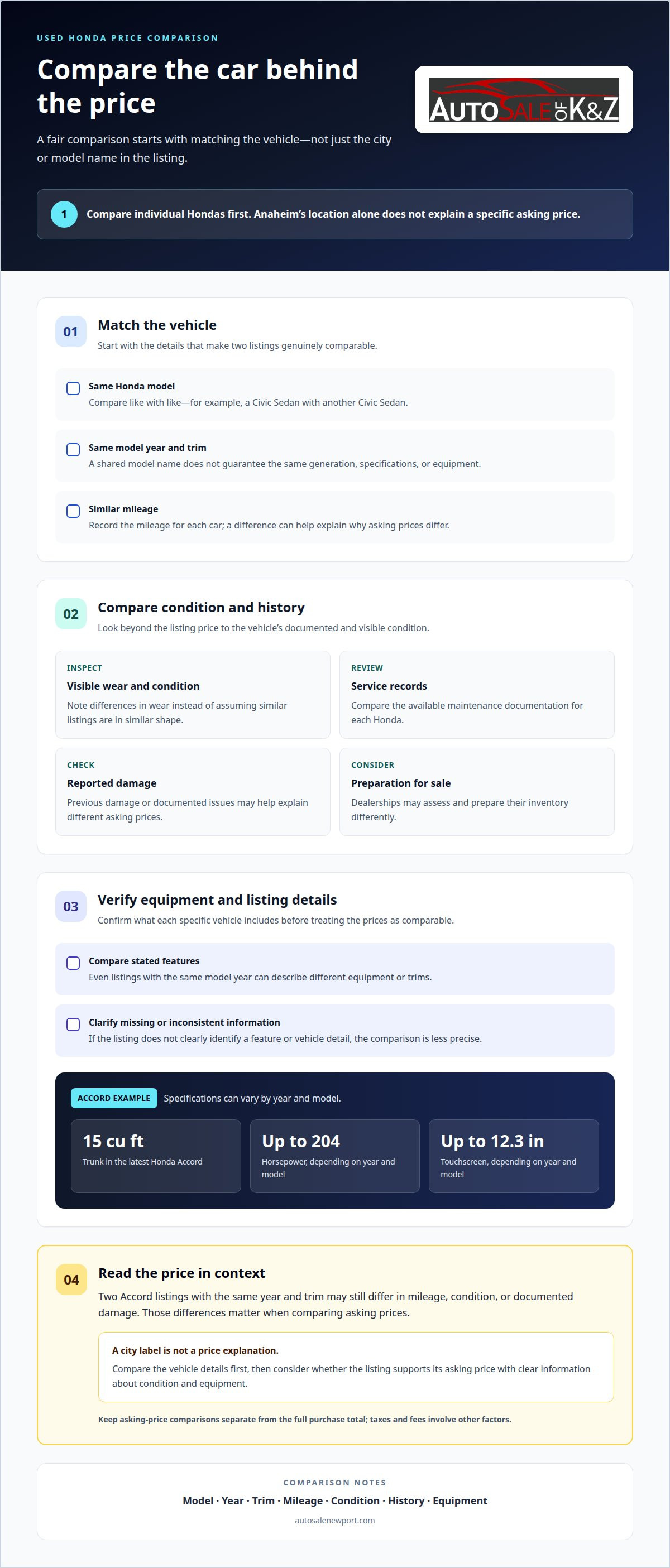
A used Honda’s price depends more on its condition and configuration than its Anaheim address. To compare Anaheim with another Orange County location, match the model, model year, trim, mileage, condition, and vehicle history. A Civic Sedan with different equipment or wear isn’t a direct comparison, even if both listings use the same model name.
Start with the same Honda model and trim, then compare vehicles with similar mileage and history. A difference in asking prices may reflect condition, equipment, service records, or previous damage. It may also reflect how each dealership assesses its inventory and prepares a vehicle for sale. A city label alone doesn’t explain the difference.
Model year matters, too. Honda may update features across generations, so a newer Accord and an older Accord can differ beyond age. The latest Honda Accord has a 15-cubic-foot trunk. Depending on year and model, an Accord can offer up to 204 horsepower and a touchscreen measuring up to 12.3 inches. Those details help distinguish what each listing describes.
Look closely at trim. Two Accord listings from Anaheim and elsewhere in Orange County may have different equipment, even if their model years match. Compare the stated trim and features rather than assuming that a shared model name means shared specifications. If a feature is unclear in a listing, the comparison is less precise.
- Match the vehicle: Compare the same Honda model, model year, and trim.
- Account for condition: Note mileage, visible wear, service history, and reported damage.
- Compare equipment: Use listed features to separate similarly named trims.
- Review the listing details: Treat missing or inconsistent information as a reason to clarify the vehicle’s description.
Consider two Accord listings with the same year and trim. If one has different mileage or documented damage, don’t expect the asking prices to be equal. Those differences help explain each price. A fair comparison looks at the vehicle behind the number, not just the number in a search result.
Location can influence how a dealership positions a vehicle, but it doesn’t explain a specific price on its own. Anaheim and nearby Orange County dealerships may have different vehicles, inventory, and preparation histories. Compare individual Hondas first, then consider whether the listing supports its price with clear details about condition and equipment.
Keep asking-price comparisons separate from a full purchase-cost comparison. This section focuses on the listed vehicle price; taxes and fees involve other factors. For each Honda, record the model year, trim, mileage, condition, and notable equipment. This makes differences easier to explain and helps prevent a mismatched feature from steering your decision.
If the same Honda is hard to find nearby, broaden your comparison to similar model years or trims, but keep those differences in view. For example, an Accord with a different touchscreen size isn’t identical just because both listings say “Accord.” Compare a used Honda dealership in Anaheim with nearby options by reviewing each vehicle’s details, rather than assuming listings in one city are automatically lower priced.
Do Anaheim dealerships offer warranties, vehicle-history reports, or return policies for used Hondas?
When considering a used Honda in Anaheim, treat warranty coverage, vehicle history, and return terms as separate parts of the purchase. One document won’t answer all three questions. A vehicle-history report describes recorded events, a warranty explains certain repair coverage, and a return policy sets conditions for bringing a vehicle back. Review each for the specific Honda, not just the dealership’s general description.
Start with the warranty paperwork. It should identify the covered vehicle, coverage provider, start point, and applicable conditions. Look for exclusions, required maintenance, claim procedures, and whether coverage transfers to another owner. If a salesperson explains coverage verbally, compare that explanation with the written document before relying on it. A warranty’s value depends on its terms, not simply the word “covered” in a listing.
Certified pre-owned status is different from a general used-car label. A Honda described as certified should come with documentation explaining what certification means for that vehicle. Ask which inspection or certification records accompany the car and whether warranty coverage is connected to that status. Don’t assume every pre-owned Honda is certified or that the term explains its condition or coverage.
A vehicle-history report can provide context about recorded ownership, title events, reported damage, and other available records. It isn’t a physical inspection and reflects information recorded in its source databases. Read it alongside the Honda’s service records and inspection findings. For example, a clean-looking summary won’t explain an unexplained gap in maintenance documentation.
Read return policies carefully, too. A written policy should say whether returns are allowed, the timeframe, eligibility conditions, and required steps. It may also describe limits based on vehicle use or condition. These details depend on the dealership’s written terms. Don’t treat a test drive, inspection period, or informal comment from a salesperson as a return agreement.
- Warranty: Identify the provider, covered components, exclusions, and claim process.
- History: Compare the report with service records and inspection information for that Honda.
- Certification: Read the vehicle-specific documentation and associated coverage terms.
- Returns: Find the written conditions, timeframe, eligibility requirements, and procedure.
For example, consider two used Honda Civic Sedans with similar descriptions. One has written warranty details and a vehicle-history report; the other has only a verbal description of its condition. The documents provide different levels of detail for evaluating the purchase. Compare the records themselves rather than assuming matching model names mean matching protections.
Before signing, review the warranty, history report, certification documents, and return policy alongside the purchase paperwork. Confirm that each identifies the correct Honda and that verbal explanations match the written terms. If a return policy or warranty condition affects your decision, resolve that point before completing the transaction. Clear documents help you distinguish coverage, history, and return options.
What fees and taxes apply when buying a used Honda from an Anaheim dealership?
The advertised vehicle price is only one part of the purchase paperwork. When buying a used Honda in Anaheim, review the itemized buyer’s order for the vehicle price, tax, registration or title charges, and any dealer-added products or services. The exact categories and amounts depend on the transaction. An itemized breakdown helps separate required charges from optional items.
Start with the Honda’s agreed selling price. The buyer’s order should show it separately from taxes, fees, and add-ons. For example, the final paperwork for a Honda Civic may show a different total from its listing because it includes additional transaction lines. Compare the selling price with the total due; they aren’t interchangeable.
Look for a separate sales-tax entry on the purchase paperwork. The document should make clear what amount is taxed and how the tax appears in the total. Don’t assume tax lines from two Anaheim dealerships will match just because both vehicles are in the same city. Transaction details and the applicable tax calculation affect the amount, so compare the written breakdown instead of estimating from the advertised price.
Registration and title charges may also appear as separate line items. Read their descriptions to understand which transaction each charge relates to. A title-related charge and a registration-related charge describe different costs, even if both appear in the vehicle paperwork. If a line has a broad label, request an itemized explanation before accepting the total.
Review dealer-added products or services separately. A buyer’s order may list them apart from the Honda’s selling price and government-related transaction charges. Check whether each item is optional, what it covers, and whether you want it included. Don’t assume an add-on is required just because it appears on a printed worksheet.
- Vehicle price: Confirm the agreed amount before reviewing additional lines.
- Taxes: Find the separate tax entry and its calculation basis.
- Title and registration: Review each description and purpose.
- Optional products: Identify what each item provides and whether you accept it.
- Final total: Reconcile every listed charge with the amount due.
Financing changes how you pay, not how you should read the paperwork. If you finance the Honda, distinguish the purchase total from the amount financed and the payment terms in the financing documents. A monthly payment alone doesn’t show every charge. Review the itemized purchase paperwork alongside the financing agreement to see how the figures connect.
A trade-in can also change the figures shown in the transaction paperwork. Keep the Honda’s agreed selling price, trade-in amount, and remaining balance on any existing loan separate. Each figure serves a different purpose in the calculation. The documents should show how the trade-in is applied, rather than folding its effect into a single combined total.
Before signing, compare the buyer’s order with the final contract. Check the Honda’s identity, agreed price, each tax and fee line, accepted add-ons, and total. If a line differs from the earlier worksheet, pause and ask for a clear written explanation. This helps you understand the full purchase cost without relying on a payment estimate or verbal summary.
How does a dealership inspect a used Honda in Anaheim, and what should buyers ask before purchasing?
An inspection should assess the specific Honda, not rely on its model name or listing description. A structured review can cover the exterior, cabin, mechanical components, and road performance. Ask for the findings and how they relate to the vehicle you’re considering. A Honda Civic Sedan, for example, should have its own condition details, not a generic model summary.
An exterior review can identify paint differences, panel gaps, glass damage, and worn or damaged lights. These observations may point to previous repairs or current cosmetic concerns. Tire condition matters, too: uneven wear can indicate alignment or suspension issues that need further assessment. Ask the dealership to explain any concern noted and whether it affects the vehicle’s readiness for purchase.
Under the hood, an inspection can check for visible fluid leaks, hose and belt condition, battery condition, and signs of poor maintenance. The engine should be assessed for abnormal sounds or warning indicators. A transmission review can consider shifting behavior while the vehicle is operating. These checks don’t replace service history, but they let the dealership document current observations.
Inside the Honda, an inspection should cover the seats, seat belts, dashboard indicators, climate controls, windows, and other installed electronics. Ask whether each listed feature was checked and whether anything needs attention. A working display, for example, doesn’t establish that every control or warning system works as expected. The inspection record should distinguish observed condition from assumptions.
A road evaluation can help assess braking, steering, suspension noises, and transmission response under normal driving conditions. Ask whether the dealership evaluated these areas and found any unusual behavior. A vehicle-history report may provide context about recorded events, but it doesn’t replace examining the current car. Review both as separate parts of the vehicle’s history and condition.
- Inspection scope: Ask which exterior, cabin, and mechanical areas were examined.
- Findings: Request a written record of concerns and their location.
- Road evaluation: Ask what the dealership observed about braking, steering, and shifting.
- Maintenance records: Ask which service documents accompany the Honda.
- Unresolved issues: Clarify whether any reported concern affects the purchase decision.
Specific questions often produce more useful answers than asking whether a Honda is “in good shape.” Ask, “Were any leaks observed around the engine?” or “Did the inspection note uneven tire wear?” Then ask how the dealership’s findings are documented. If the inspection identifies a concern, ask what it means for the car’s condition and whether related records are available.
Before signing, connect the inspection report to the exact vehicle identification and the terms in the purchase paperwork. Confirm that the report describes the Honda you’re considering, not another vehicle with a similar model name. For a used Honda in Anaheim, these questions help turn an inspection into specific, understandable information. Discuss inspection details before choosing a used Honda.
Auto Sale Newport: Honda Civic Sedan
Auto Sale Newport offers used Honda Civic Sedans for shoppers considering a pre-owned Honda. If a Civic fits your needs, review the vehicle-specific details, including condition, history, and purchase paperwork. The earlier sections explain how to compare those details and which questions can clarify the transaction.
A Civic isn’t the only option to consider if you’re weighing different driving needs. Auto Sale Newport also offers the Toyota Prius, Tesla Model 3, and Tesla Model Y. Comparing the models that interest you can help narrow your choice without losing sight of each vehicle’s individual records and terms.
For help discussing a Honda Civic Sedan or your next step, contact Auto Sale Newport.
Choose the Honda that fits your next chapter
Make your next step a decision about fit, not just a choice between listings. Before choosing a used Honda dealership in Anaheim, consider how the car needs to serve your everyday routine. Think about your commute, passenger space, parking needs, and how often you carry larger items. Clear priorities can help you focus on a Honda that suits your life.
It also helps to decide which trade-offs feel acceptable. You might prioritize a familiar driving experience, a comfortable cabin, or flexibility for changing plans. Keep those preferences in mind as you compare available vehicles, and give yourself time to ask direct questions before committing. A thoughtful choice should feel clear, not rushed.
If you’re ready to explore your options, contact Auto Sale Newport to take the next step. Bring your priorities and questions into the conversation, then move forward at a pace that feels right for you.
Frequently Asked Questions
Which used Honda dealerships are located in Anaheim, California?
Auto Sale Newport is located in Fullerton, not Anaheim, and serves shoppers from Anaheim and surrounding communities. Its used inventory includes a Honda Civic Sedan. If you’re comparing locations, distinguish a dealership’s physical address from the areas it serves. That helps you plan where to view a vehicle and understand whether a listing represents a dealership in Anaheim or a nearby city.
What used Honda models and model years are available at Anaheim dealerships?
The Honda model offered by Auto Sale Newport is the Honda Civic Sedan. Its model year is specific to the individual vehicle, rather than a fixed range applying to every Civic listing. For Anaheim-area shoppers, compare the model year and vehicle details shown for the particular car. Before purchasing, verify its price, mileage, equipment, and terms with Auto Sale Newport.
What are the prices of used Honda cars at dealerships in Anaheim?
Listed total prices exclude taxes, license, registration, finance charges, and other government-required charges. There are no hidden fees, and add-ons are optional. Availability and details may change without notice; verify vehicle details before purchase. Auto Sale Newport is an independent dealership, not affiliated with Tesla.
What are the hours, addresses, and contact details of used Honda dealerships in Anaheim?
Auto Sale Newport’s showroom is at 1565 W Commonwealth Ave, Fullerton, CA 92833, serving Anaheim-area shoppers. Sales hours are Monday through Saturday, 10 am to 7 pm, and Sunday, 11 am to 5 pm. Call or text (949) 339-2004 for assistance with the Honda Civic Sedan or other used inventory. The Fullerton address is the dealership location, not an Anaheim address.


