

Can a student finance a used car in Fullerton without a long credit history or a predictable paycheck? It may be possible, but the right fit depends on more than the monthly payment. Fullerton auto financing for students starts with understanding what lenders may consider, how a co-signer could share responsibility, and what a car will cost to own.
When you’re budgeting around classes, work, and other expenses, comparing loan offers and vehicles can feel overwhelming. Start by listing your regular expenses, estimating the full cost of owning a car, and deciding what monthly payment leaves room for unexpected costs. This guide explains what to prepare before applying, how to compare interest rates, loan terms, and total repayment costs, and how to set a realistic budget.
You’ll also learn how to weigh used-car choices against your needs and budget, rather than focusing on the payment alone. At Auto Sale Newport, students can browse pre-owned inventory online, compare vehicles alongside financing options, and visit the Fullerton showroom for a test drive. The goal is to help you approach your purchase with useful questions and a clearer picture of what fits.
Key Takeaways
- Set a car budget that accounts for ownership costs as well as a manageable monthly payment.
- For Fullerton auto financing for students, understand that lenders may consider credit history, income, existing obligations, and application details.
- Compare APR, loan length, total repayment, and disclosed fees, since a lower monthly payment can mean paying for longer.
- Prepare identification, income details, and any other information requested by the lender before you begin the purchase process.
- Explore pre-owned vehicles online and compare them with financing options at Auto Sale Newport’s Fullerton showroom.
Fullerton Auto Financing for Students: Start With a Realistic Car Budget
Between classes, work shifts, and changing schedules, dependable transportation can make student life easier. But limited credit history or irregular income can make it harder to decide what kind of purchase is manageable. With Fullerton auto financing for students, look beyond the loan payment: your budget should account for the costs of owning and operating a vehicle, too.
A monthly payment that seems comfortable on its own may leave little room for insurance, fuel or charging, registration, and routine upkeep. List these costs before comparing vehicles. That way, you can set a budget based on the full cost of ownership, not just the amount due to the lender each month.
What should a student include in a car budget?
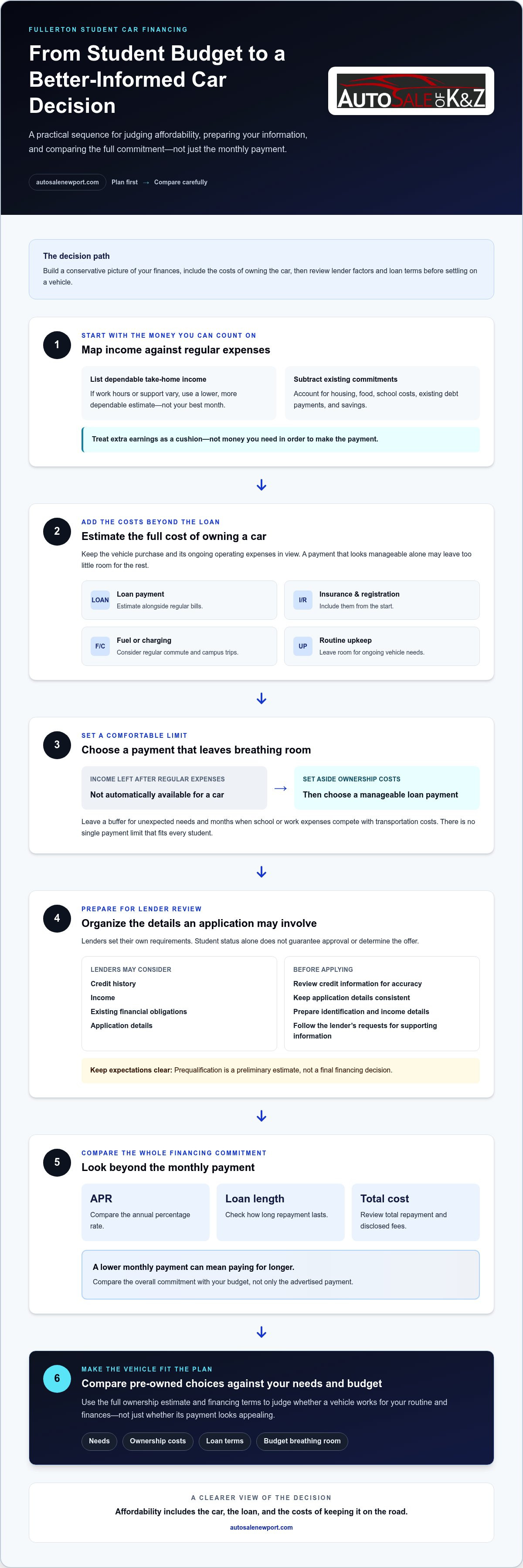
Separate the vehicle’s purchase price from the recurring costs of keeping it on the road. Financing terms affect what you repay for the purchase, while operating expenses continue throughout ownership. Start with this checklist:
- Loan payment: Estimate what you could manage alongside your regular bills.
- Insurance and registration: Include these ownership expenses in your plan rather than treating them as afterthoughts.
- Fuel or charging: Consider how your commute, campus trips, and other regular driving affect energy use.
- Routine upkeep: Leave room in your budget for ongoing vehicle needs.
Then account for less predictable parts of student finances. Work hours may change between semesters, and school expenses or unexpected needs can compete with transportation costs. A buffer helps keep one busy or expensive month from making the car payment feel unmanageable. For ideas on comparing local pre-owned options, see this used cars near Cal State Fullerton guide.
How can Fullerton students set a comfortable payment limit?
Begin with take-home income, then subtract regular expenses such as housing, food, school costs, existing debt payments, and savings. The amount left over is not automatically available for a car. Set aside room for the recurring ownership costs above, then decide what payment would still leave breathing room in an ordinary month.
If your earnings or financial support vary, use a conservative estimate instead of building a plan around your best month. For instance, if your work hours fluctuate, base your budget on a lower, more dependable income level. Treat extra earnings as a cushion, not money you need to make the payment.
There’s no single payment limit that fits every student. Your expenses, income stability, and transportation needs all matter. Understanding how loan terms shape repayment can help you evaluate a payment in context; Car finance on Wikipedia provides a general overview of financing concepts. Compare the overall commitment with your budget, not just the payment advertised for a vehicle.
How Student Auto Financing Works: Credit, Income, and Application Details
Auto financing is borrowing money to purchase a vehicle and repaying it under agreed loan terms. For Fullerton auto financing for students, understanding what a lender may evaluate can make the application feel less mysterious. Credit history, income, existing financial obligations, and application details may all be considered. Each lender evaluates applications according to its own requirements, so being a student alone neither guarantees approval nor determines the offer.
Prequalification is a preliminary estimate, not a final financing decision. It can help you understand a possible direction, but the final decision and terms depend on the lender’s review. The terms involve more than a monthly payment, so read them carefully before agreeing. For a student-focused overview of common considerations, Student Car Loans: How To Get Approved discusses challenges such as limited credit history and income.
Can a student apply with limited or no credit history?
Yes, but there isn’t one universal result. Lender requirements differ, and a short credit history may be considered alongside other application details. Before applying, review your credit information for accuracy and note what accounts or payment history appear. Provide complete, truthful information and keep expectations realistic while the lender evaluates your application.
Income helps show the resources available for loan payments, while existing obligations provide context about other financial commitments. If you have part-time earnings, for example, report them accurately rather than assuming a variable schedule automatically rules out financing. The lender makes its decision based on the full application and its own criteria, not on student status alone.
Before submitting an application, organize the details you expect to use and check that they’re consistent. If a lender requests supporting information, follow its instructions rather than guessing what will be accepted. Preparation can help you respond clearly and understand what the application asks, without treating a preliminary estimate as a promise.
When might a co-signer be part of the application?
A co-signer may be considered if an applicant has limited credit or income, but their involvement is a serious financial commitment. Depending on the loan agreement, a co-signer can be responsible for repayment if the primary borrower doesn’t pay. Before proceeding, both people should review the proposed terms, understand their responsibilities, and discuss how payments will be handled if circumstances change.
Make the conversation specific. Discuss who will make payments, how each person will keep track of them, and what the agreement means for the co-signer if the borrower’s income changes. Don’t treat a co-signer as a formality or assume their participation ensures approval or particular terms. The lender still evaluates the application and makes the financing decision.
Once you understand the factors involved, compare financing options alongside pre-owned vehicles that suit your needs. Explore pre-owned vehicles and financing options as you consider your next steps.
Compare Student Car Financing Offers by Total Cost, Not Payment Alone
A manageable monthly payment matters, but it doesn’t show the whole financing picture. For Fullerton auto financing for students, compare written offers side by side using the same vehicle price and down-payment assumptions. If those inputs differ, a payment may look lower simply because the amount borrowed is smaller, making it harder to judge the financing terms fairly.
Use a simple comparison like this, filling in each column from the written offer. If a figure isn’t shown, mark it as undisclosed rather than estimating it.
| Term | Offer A | Offer B |
|---|---|---|
| APR | Record stated APR | Record stated APR |
| Loan term | Record repayment period | Record repayment period |
| Monthly payment | Record stated payment | Record stated payment |
| Total repayment | Record stated total | Record stated total |
| Fees and other terms | Note disclosed details | Note disclosed details |
Which financing terms should students compare?
APR is the annual percentage rate shown for borrowing. The loan term is how long the repayment period lasts, and the monthly payment is the scheduled amount due each month. Total repayment is what you’ll pay across the loan according to the offer. Fees and other agreement terms may affect the full comparison, so review the documents rather than relying on a headline payment.
Compare each offer using the same vehicle price, down payment, and relevant assumptions. A Fullerton used-car deals guide can also help you think through vehicle shopping while reviewing financing options.
How can a student avoid focusing only on the monthly payment?
Read the payment and total repayment together. A longer repayment period can reduce the scheduled monthly amount while extending how long you owe and potentially increasing the total paid. Decide whether that longer commitment makes sense for your budget and the used vehicle you’re considering, not just whether the first payment feels comfortable.
The down payment matters, too. Changing it changes how much you need to finance, so use the same amount when comparing offers. If you’re considering different down payments, compare each scenario separately and note how both the payment and total repayment change. This keeps the choice clear instead of blending different assumptions together.
Before deciding, review the complete written terms and make sure the figures in your comparison refer to the same purchase assumptions. The offer with the lowest monthly payment may not have the lowest total cost. A side-by-side review helps you weigh affordability now against the full repayment commitment over time.
Prepare for a Fullerton Student Car Purchase Before Visiting the Dealership
A little preparation can make a dealership visit more focused. Before shopping, organize your budget and application details, then decide what a vehicle needs to do for your daily routine. This keeps the decision grounded in practical needs instead of letting one appealing model or payment shape the whole plan.
Use this sequence to get ready for Fullerton auto financing for students:
- Set a budget. Decide what you can manage after accounting for your regular expenses and the costs of owning a car.
- Gather application information. Prepare accurate personal, housing, and income details that an application may request.
- Shortlist vehicles. Identify pre-owned options that suit your commute, parking situation, and expected use.
- Compare terms. Review written financing offers using consistent vehicle-price and down-payment assumptions.
- Review documents. Read the proposed agreement carefully and make sure you understand the terms before proceeding.
What should students gather before exploring financing?
Keep your information accurate and easy to refer to. Depending on the application, you may be asked for identification, income details, housing information, or other lender-requested details. Requirements vary, so don’t assume every application asks for the same items. Bring your budget notes and any financing offers you already have; they can help you keep the discussion and comparisons organized.
If you’re considering a co-signer, talk through the role before including them. Both of you should understand the proposed loan terms and the financial responsibility described in the agreement. Clear expectations matter, especially if your work hours or income change during the school year.
How should students shortlist a used car?
Start with your routine, not a model name. Think about how far you’ll drive, how many passengers or belongings you typically carry, and the parking available at home, work, or campus. A compact car may suit one student’s commute and parking needs, while another may prioritize more room. There’s no single vehicle choice that fits everyone.
As you compare pre-owned options, consider the vehicle’s condition, intended use, and fit with your budget. Browse Auto Sale Newport’s online inventory to identify vehicles for a closer look, then visit the Fullerton showroom for a test drive. The Fullerton used-car buyer’s guide can also help you think through the shopping process.
Before settling on a specific vehicle, compare it with your shortlist and return to your budget and financing notes. Review the purchase documents and proposed terms carefully so you understand the commitment. Browse pre-owned vehicles at Auto Sale Newport as you prepare for your Fullerton car purchase.
Explore Student Auto Financing and Used Cars at Auto Sale Newport
Once you’ve considered your budget and compared financing terms, look for vehicles that fit your everyday needs. Auto Sale Newport is a used-car dealership in Fullerton offering financing options, so students can explore pre-owned vehicles alongside their purchase considerations. Review the financing terms alongside your vehicle choice to keep the decision grounded in your budget.
Students in Fullerton and across Orange County, LA, Riverside, Long Beach, Bakersfield, San Bernardino, Corona, San Diego, Anaheim, Buena Park, Santa Ana, and Orange can browse the inventory online. Visit the showroom at 1565 W Commonwealth Ave to view vehicles and take a test drive. Seeing a vehicle in person gives you a chance to consider how it feels for your commute, whether its size works for your parking situation, and how well it suits your expected use.
What can students do at the Fullerton dealership?
At the showroom, shoppers can explore pre-owned vehicles, including Tesla Model 3 and Model Y, Toyota Prius, Corolla, Camry and RAV4, Lexus IS Turbo, and Honda Civic Sedan. Compare the vehicles with your needs and budget, and discuss financing options as part of your purchase planning.
If you have a vehicle to trade, Auto Sale Newport offers on-site appraisals and trade-in valuations. A valuation gives you another piece of information to consider as you plan your purchase, alongside your budget and financing offer.
- Bring your budget: Know what you’ve set aside for the payment and other ownership costs.
- Bring your questions: Note anything you want clarified in the written financing terms.
- Think about your routine: Consider commuting, parking, passenger space, and regular use.
- Take a test drive: Experience a vehicle in person before deciding whether it suits you.
What is a practical next step after comparing financing?
Bring your realistic budget and questions about the proposed terms when you explore vehicles. Compare a suitable option with your commute, school and work schedule, and ongoing ownership costs. A car that fits the payment but doesn’t work for your day-to-day needs may not be the right match. Likewise, an appealing vehicle should still make sense in the context of your full budget.
For students considering Fullerton auto financing for students, comparing the vehicle and the financing together can make the decision clearer. Take time to explore your options, review the terms, and decide what aligns with your circumstances.
Explore current pre-owned inventory online, or visit Auto Sale Newport’s Fullerton showroom to view vehicles and take a test drive.
Take Your Next Car-Buying Step With Confidence
Your first car purchase doesn’t have to answer every future transportation need. Focus on choosing an option that makes sense for your life now, while leaving enough room in your budget for school, work, and changes in your routine. A thoughtful decision is one you can explain to yourself: why the vehicle suits your needs, how the financing fits, and what you’re agreeing to repay.
That kind of clarity is the goal of Fullerton auto financing for students. Use the information you’ve gathered to explore pre-owned vehicles at a comfortable pace, consider how each one fits your day-to-day life, and take time to understand the purchase terms. If you have a car to trade, a valuation may also help you plan your next step.
Auto Sale Newport offers financing options and a local place to explore pre-owned vehicles. Explore used cars and financing options at Auto Sale Newport, then decide which possibilities are worth a closer look. You can move forward one clear choice at a time.
Frequently Asked Questions
Can a college student get auto financing in Fullerton?
Yes, a college student may be able to get auto financing in Fullerton, but eligibility and terms depend on the lender’s review. For Fullerton auto financing for students, enrollment alone doesn’t determine the outcome. Lenders may assess the full application, including income and financial obligations. Before applying, decide what vehicle you’re considering and how its costs fit your situation, so you can evaluate any offer carefully rather than assume financing is assured.
Can I finance a car with no credit history as a student?
Possibly. Having no established credit history doesn’t mean every lender will reach the same decision. Before applying, review your credit reports for accounts or errors you may not recognize, and be ready to explain your financial situation accurately. If you’ve paid bills or other obligations consistently, keep a clear record of those details, but don’t assume they substitute for a lender’s evaluation or guarantee specific terms.
Should a student use a co-signer for auto financing?
A co-signer may be worth discussing if your credit history or income is limited, but it’s not a casual favor. The co-signer may become responsible for the debt under the loan agreement, and missed payments can affect both people financially. Before deciding, review the agreement together and discuss how payments will be managed if your income, enrollment, or living arrangements change. Choose this route only if both people understand the commitment.
How much should a student budget for a car payment?
There’s no universal payment amount that fits every student. Start with the money reliably available after essential bills, then reserve room for insurance, fuel or charging, registration, and other ownership expenses. For example, if income changes between school terms, base your plan on a lower, dependable month rather than a busier work period. The payment should leave enough flexibility for ordinary expenses instead of consuming your entire transportation budget.
Does applying for auto financing affect my credit score?
It can, depending on how the lender checks your credit. A full application may involve a hard inquiry, which can affect a credit score; preliminary prequalification may use a soft inquiry or a hard one, depending on the lender and process. Before submitting information, read the inquiry notice or ask how that particular check will be reported. Don’t assume every application or prequalification works the same way.
What documents might a student need to apply for car financing?
Requirements vary, but an application may request identification, income information, and details about your address or housing. Some lenders may request supporting documents, so follow the instructions for the specific application rather than relying on a generic checklist. Keep the information consistent across forms, and have a copy of any written offer you’re comparing. If there’s a co-signer, they may need to provide application details as well.
Can students get financing for a used car in Fullerton?
Yes, financing may be available for a pre-owned vehicle, subject to the lender’s review and the agreement offered. Auto Sale Newport is a Fullerton used-car dealership with financing options, and students can compare them alongside pre-owned inventory. The vehicle and financing decision go together: review the written terms against your budget and intended use. No particular approval, rate, or loan term is guaranteed.
Is a longer auto loan term better for a student?
Not necessarily. A longer term may lower the scheduled monthly payment, but it also means repaying over more time and can increase the total amount paid. Compare that trade-off with your likely time in school, income stability, and how long you expect to keep the vehicle. A payment that looks easier at first isn’t automatically the more affordable choice if the extended commitment strains your plans.


