

A car advertised with no payments for 2 months doesn’t mean the vehicle is free during that period; it means the first scheduled payment may be delayed under the financing terms. The agreement determines when payments begin and how the deferred period affects the loan. In Fullerton, the key is to understand those terms before deciding whether the timing fits your budget.
It’s reasonable to focus on the first payment date when you’re planning a car purchase. But that date is only one part of the financing picture: the loan amount, payment schedule, and total obligation also matter. This article explains what a two-month payment delay can mean, what financing details to review, and how to compare that arrangement with buying a used vehicle through Auto Financing. You’ll also learn how Auto Sale Newport’s used-car options, including Toyota and Tesla models, may fit into your decision.
Key Takeaways
- A delayed first car payment changes when payments begin; review the financing agreement to understand the schedule and overall obligation.
- Milestones describe skills most children can do by a given age, not a deadline every baby must meet.
- Notice how your baby responds to voices, faces, and interaction, and use a milestone checklist to keep track of developing communication.
- Auto Sale Newport offers used Tesla Model 3 and Model Y vehicles, along with Toyota Prius and Corolla models, for readers considering their next car.
What rules or cancellation terms apply to a 2-month commitment?
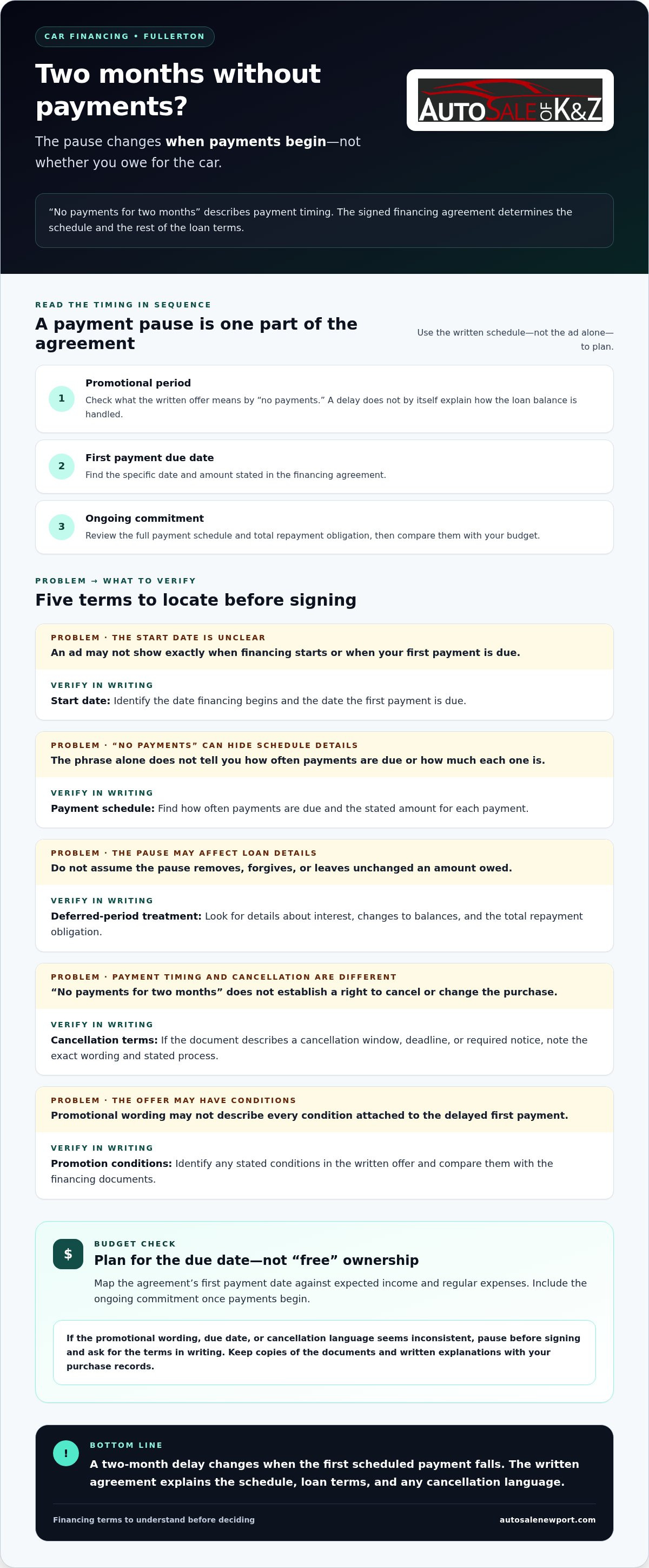
A “no payments for two months” offer concerns payment timing, not whether you owe for the car. The signed financing agreement sets the payment schedule and other loan terms. Before signing, identify the first due date, the amount due then, and what happens during the payment pause. Treat each item as part of your decision, not fine print to review later.
Ask what “no payments” means in the specific written offer. It may describe a delayed first scheduled payment, but that wording alone doesn’t explain how the loan balance is handled. Read the financing documents for details about interest, the total repayment obligation, and whether the deferred period changes later payments. Don’t assume a pause removes or forgives an amount owed.
Use the paperwork to compare the offer with your budget. Find the first payment date, then map it against your expected income and regular expenses. For example, if the agreement sets a due date after the promotional period, plan for that date rather than treating the first two months as free ownership. Also account for the ongoing commitment once payments begin.
Before you agree, locate these details in the written documents:
- Start date: Find the date the financing begins and the date the first payment is due.
- Payment schedule: Identify how often payments are due and the stated amount for each payment.
- Deferred-period treatment: Look for language explaining whether interest accrues or balances change during the pause.
- Cancellation terms: Read what the agreement says about ending or changing the transaction after signing.
- Promotion conditions: Identify any stated conditions attached to the delayed first payment.
Cancellation deserves separate attention. A sales conversation, an advertisement, and a signed financing agreement may explain different parts of a purchase. Compare the written terms rather than relying on a verbal summary. If a document describes a cancellation window, deadline, or required notice, note the exact wording and follow the stated process. Don’t infer a cancellation right from the phrase “no payments for two months.” The payment offer and the terms for ending a purchase are distinct subjects.
Consider a simple example: an offer advertises a delayed first payment, while the agreement lists a specific due date. Use the agreement’s schedule to plan. If the due date, promotional wording, or cancellation language seems inconsistent, pause before signing and ask for the terms in writing. Keep copies of the documents and any written explanation with your purchase records.
There’s also a separate meaning of “milestone” in child development: according to the Centers for Disease Control and Prevention, developmental milestones are skills that most children, defined as 75% or more, can do by a given age. That definition concerns a child’s development, not a car-financing rule. For this purchase, focus on the written dates, conditions, and cancellation language that apply to your agreement.
Ultimately, a two-month delay changes when the first scheduled payment falls; it doesn’t answer every question about the loan or cancellation. Read the full agreement before committing, and make sure you can identify the first due date and what happens if you want to end or change the transaction. These details help you assess whether the timing works for your finances.
Your Baby at 2 Months
At 2 months, early communication often appears through a baby’s face, sounds, and responses to familiar interaction. According to the Centers for Disease Control and Prevention, most babies at this age calm down when spoken to or picked up, look at faces, show happiness when someone approaches, and smile when spoken to or smiled at. These behaviors offer practical things to notice during everyday care.
A milestone checklist can help you observe patterns without turning each moment into a test. Choose a quiet time when your baby is awake, then note what happens during a familiar interaction. For example, speak gently, pause, and watch whether your baby looks toward your face, becomes calmer, or smiles. Repeat your observation during ordinary routines, such as changing or cuddling.
At this age, communication is more than spoken words. Most babies make sounds other than crying and react to loud sounds. Listen for coos or other small vocal sounds during calm moments. Notice whether your baby startles, pauses, or otherwise responds to a loud sound. Record what you observe in plain language rather than deciding that one response proves a skill.
A simple checklist might include these observations:
- Comfort: Does your baby settle when you speak or pick them up?
- Looking: Does your baby look at a face during close interaction?
- Social response: Does your baby show happiness when someone approaches?
- Smiling: Does your baby smile when spoken to or smiled at?
- Sounds: Do you hear sounds other than crying?
- Hearing response: Does your baby react to a loud sound?
Write down the situation alongside each observation. “Looked toward me while I spoke after feeding” gives more context than a bare checkmark. A note can also say “not observed today.” That records what happened without treating one missed moment as a conclusion about development. Revisit the checklist during everyday interactions and share your notes at a routine health visit.
Movement can be part of observation too, but keep the setting safe. During awake tummy time, a 2-month-old may be able to lift their head at about a 45-degree angle. Stay with your baby while they’re on their stomach. For naps and bedtime, place your baby on their back in a safe sleep area. These are different situations, so a tummy-time observation should never become a sleep position.
Use brief, natural opportunities rather than trying to prompt every behavior in one sitting. Smile and speak during face-to-face time. Pause after talking so your baby has a chance to respond with a look, expression, or sound. If your baby is tired or upset, return to the checklist another time. The goal is to notice communication as it happens in familiar routines.
Babies develop at their own pace, so a checklist is a record, not a diagnosis. If your baby isn’t meeting one or more milestones, loses a skill they previously had, or you have another concern, talk with your child’s doctor and ask about developmental screening. Bring specific examples, such as changes in smiling, responding to voices, or making sounds. Clear notes can make it easier to explain what you’ve noticed and when it happens.
Over time, those observations create a more useful picture than one isolated interaction. Keep the checklist simple, describe what you see, and update it as new behaviors appear. At 2 months, everyday exchanges with a familiar caregiver can provide meaningful opportunities to notice early communication.
Auto Sale Newport: Tesla Model 3
Auto Sale Newport can help you explore used-car options when you’re ready to move from comparing payment timing to choosing a vehicle. If a Tesla is on your list, consider the Tesla Model 3 or Tesla Model Y. You can also compare the Toyota Prius and Toyota Corolla as different options for your needs.
A delayed first payment is only one part of a financing decision. Compare the vehicle you’re considering with the written payment schedule and your budget after payments begin. That way, the timing offer doesn’t overshadow the longer-term commitment. Auto Sale Newport offers auto financing alongside its used-car selection, giving you a place to discuss your purchase choices.
For a straightforward conversation about vehicle options and financing, contact Auto Sale Newport.
Choose a Payment Plan That Fits Beyond the First Date
Use the timing of your first payment as a starting point, not the only measure of affordability. A vehicle decision should also fit your budget once regular payments begin. Before moving ahead, compare the financing terms with your planned expenses and choose a car that suits your day-to-day needs.
If a delayed first payment is part of your plan, discuss the written terms alongside your vehicle options. Auto Sale Newport offers used Tesla Model 3 and Tesla Model Y vehicles, as well as the Toyota Prius. Consider which model suits your priorities, then evaluate the financing details with the car in mind. A no-payment period for 2 months should never distract from understanding the full commitment.
Contact Auto Sale Newport to discuss your options and take the next step with a clearer picture of your purchase.


