

Yes, you can trade in two cars for one. The answer to “Can I trade in two cars for one?” depends on each car’s trade-in value and any loan payoff, plus the price and costs of the vehicle you’re buying. If the combined net value covers the amount due, you may not need financing. If it falls short, you’ll need to cover the difference with cash or a loan.
Trading in two cars can feel complicated, especially if either still has a loan. Start by comparing each car’s trade-in value with its payoff, then see how the combined equity applies to your next purchase. This guide explains appraisals, positive and negative equity, and loan payoffs, including what changes if you plan to pay without financing. At Auto Sale Newport, you can arrange an on-site appraisal for each vehicle and discuss financing options for a used-car purchase.
Key Takeaways
- Two vehicles can go toward one purchase, but their combined trade value is only part of the calculation.
- Subtract each vehicle’s loan payoff from its trade value to see how positive and negative equity affect the deal.
- Separate appraisals help clarify what each car contributes, while ownership and loan paperwork can affect how the trade-in is completed.
- If the combined equity doesn’t cover the purchase and related costs, the remaining balance may require cash or financing.
- Trading two vehicles can also be an option when buying a used car; the payoff and purchase details shape how the transaction works.
Calculating combined equity and loan payoffs
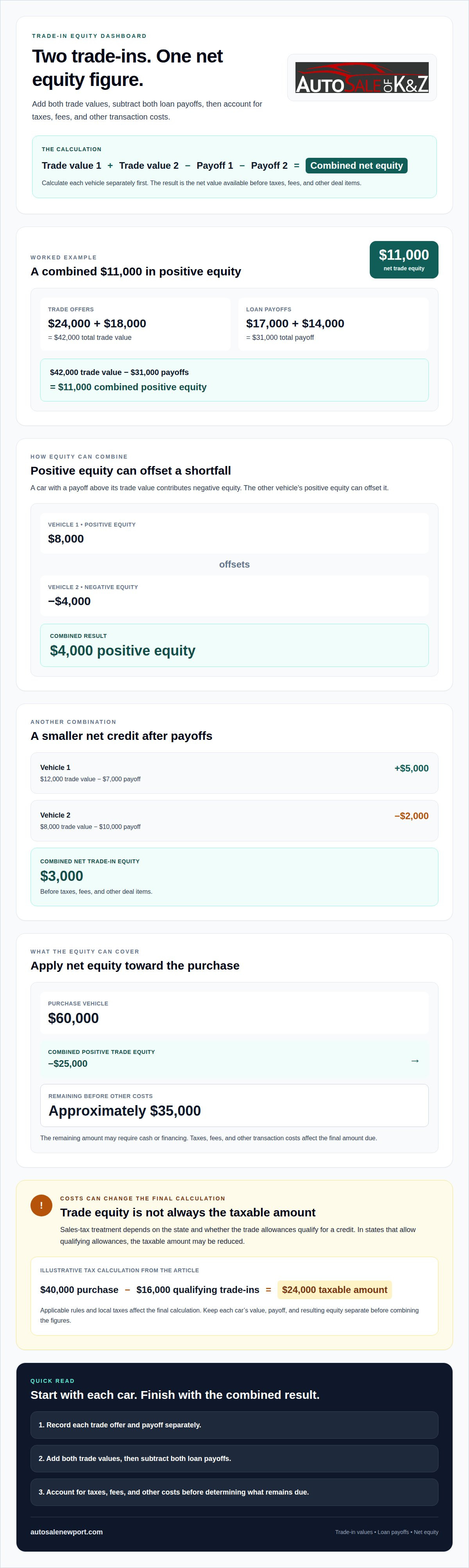
To calculate combined equity, add the two trade-in values and subtract each car’s loan payoff. The result is the net value available before taxes, fees, and other transaction costs.
Combining Equity Across Both Cars
Combined equity is the total value of both trade-ins minus the loans attached to them. It matters because positive equity from one car can offset negative equity from the other. For example, $8,000 in positive equity can offset $4,000 in negative equity, leaving $4,000 in combined positive equity. If both loan balances exceed their vehicles’ values, the overall balance is negative.
Applying or Splitting Combined Equity
Combined equity may be shown as one credit toward the purchase or allocated among the transaction’s items. The calculation affects how much remains to cover after the trade-ins. For example, $25,000 in combined positive trade equity toward a $60,000 vehicle leaves approximately $35,000 before other costs. A clear breakdown helps distinguish the trade credit from taxes, fees, and other amounts due.
Combining Trade-In Values and Payoffs
Add both trade offers, then subtract each car’s payoff to find net equity. This matters because gross trade values don’t show what remains after loans are settled. For example, trade values of $24,000 and $18,000 total $42,000; payoffs of $17,000 and $14,000 total $31,000. The difference is $11,000 in combined positive equity.
A different combination can produce a smaller credit. A vehicle worth $12,000 with a $7,000 payoff contributes $5,000 in equity. Another worth $8,000 with a $10,000 payoff contributes $2,000 in negative equity. Together, they leave $3,000 in combined net trade-in equity before taxes, fees, and other deal items.
What are the risks or fees when trading in two cars? The main risk is negative equity, which occurs when the combined payoffs exceed the combined trade values. That shortfall must be addressed in the transaction, and taxes, fees, and other costs can change the final amount due.
Sales tax treatment depends on the state and whether the trade allowances qualify for a credit. In states that allow qualifying trade-in allowances, the taxable amount may be reduced by those allowances. For example, a $40,000 purchase with $16,000 in qualifying trade-ins may leave $24,000 as the taxable amount. The applicable rules and local taxes affect the final calculation.
Keep each figure separate before combining them: the value of each car, its loan payoff, and the resulting net equity. For example, when trade values total $42,000 and loan payoffs total $31,000, the $11,000 difference is the starting equity calculation. Taxes, fees, and other deal items still affect the final amount available toward the purchase.
Can You Trade In Two Vehicles for One?
Yes. A dealership can accept two vehicles as trade-ins toward one purchase, with each car handled separately. The paperwork needs to identify both vehicles, their owners, and any loans so the trade values and payoffs are recorded accurately.
For each car, the title is central to transferring ownership. Bring the title if available, along with current registration and identification for the titled owner. If there’s a loan, bring the lender’s name and account or loan details. This information helps establish the payoff amount and link the loan to the correct vehicle.
Useful documents and information for each trade-in include:
- Title: Identifies the owner and supports the ownership transfer.
- Registration: Helps match the vehicle to its records.
- Owner identification: Connects the person completing the transaction with the title.
- Loan details: Helps identify the lender and the payoff tied to that car.
- Vehicle information: The make, model, and identifying details help keep each car’s appraisal and paperwork distinct.
Keep the documents grouped by vehicle rather than combining them into one pile. Put the first car’s title and loan details together, then do the same for the second. This makes it easier to match each appraisal with the correct owner and payoff, and reduces the risk of applying one lender’s information to the wrong car.
Ownership matters. If a car is titled in someone else’s name, that owner’s permission and required signatures are usually needed for the trade-in. If a vehicle has multiple owners, each person whose signature is required must participate. Missing paperwork from one owner can delay the transaction, even when the other car’s documents are ready.
For a financed vehicle, the payoff figure can change as payments are made. The lender’s current payoff information helps determine how much of the trade value remains after settling the loan. Keep the two payoff details separate so each amount is matched to the correct car before calculating combined equity.
Before signing, review the paperwork for both vehicles and the purchase vehicle. Confirm that the trade-in descriptions, owners, and loan information correspond to the right cars. Clear, separated records make the two-trade transaction easier to follow. Organize your trade-in details by vehicle to keep the paperwork straightforward.
How Are Two Trade-In Values Determined?
Each vehicle receives its own appraisal, so its condition and details affect its offer independently. Once both appraisals are complete, the dealership combines the offers in the purchase calculation. This keeps each car’s value visible instead of treating two different vehicles as one.
The appraiser considers identifying details and assesses each vehicle separately. Mileage, condition, equipment, and visible wear help determine its offer. A sedan with clean upholstery and minor exterior wear may be valued differently from an SUV with damaged trim or worn tires. The model, configuration, and condition all contribute to the individual appraisal.
A separate appraisal typically considers:
- Vehicle identity: The make, model, year, and trim help identify the car being evaluated.
- Odometer reading: Mileage is recorded for that specific vehicle.
- Interior and exterior condition: Appraisers note visible wear, damage, and cleanliness.
- Equipment and features: The vehicle’s configuration helps distinguish it from similar models.
- Mechanical condition: The appraiser considers how the vehicle operates during its evaluation.
Keeping the inspections separate matters. If one car has higher mileage and more visible wear, those details affect its appraisal, not the other car’s value. Likewise, stronger condition in one trade-in doesn’t cancel out issues found in the second. Each offer reflects the vehicle presented for inspection.
After both offers are established, the dealership adds them to calculate the combined trade-in value. That total goes into the purchase calculation, while each loan payoff remains linked to its own vehicle. Appraisals estimate trade values; payoff figures show how much is needed to settle each loan.
Clear itemization makes the results easier to understand. The paperwork should list each vehicle and its trade value separately, then show the combined amount. If an inspection changes an offer, the adjustment should be associated with the correct car. This helps explain why two vehicles with similar asking prices may receive different trade offers.
For a smoother evaluation, present both cars for individual inspection and keep their identifying and loan information distinct. An itemized trade-in appraisal helps show how each vehicle contributes to the combined offer.
Can You Trade Two Cars for One Without Financing?
Yes, if the net value from both trades, plus any cash you add, covers the purchase and related costs. Compare that total with the full amount due, not just the vehicle’s advertised price.
For example, trading two cars with combined trade value of $25,000 toward a $40,000 SUV leaves about $15,000 of the purchase price to cover. That simplified calculation excludes taxes, fees, and other deal items. If you pay the remaining balance in cash, you can complete the purchase without a new auto loan. If your trade equity and cash do not cover the total, financing may be needed for the shortfall.
A lower-priced vehicle may make a purchase without financing more achievable, but the same calculation applies. Add the two trade values, subtract any loan payoffs, then compare the resulting equity with the purchase amount and related costs. Positive equity contributes toward the deal. Negative equity reduces the available amount and may leave more for you to pay.
Two financed trade-ins involve separate payoffs, even when both are exchanged for one vehicle. The dealership and lenders need to complete the payoff process for each existing loan. Once those balances are accounted for, any remaining equity can reduce the new purchase amount. If the payoffs exceed the combined trade values, you’ll need to address the shortfall.
Financing changes how you cover the balance, not how the trade values are calculated. A new loan may cover the remaining purchase amount, including a payoff shortfall carried into the transaction. The amount financed may therefore exceed the vehicle’s price alone. Taxes, fees, loan payoffs, and cash down can all affect the final amount.
Financing is subject to lender approval. The application and proposed loan amount take into account the vehicle price, available trade equity, any remaining payoff shortfall, and other deal costs. Reviewing these figures together helps explain why a financing offer may differ from a simple price-minus-trades calculation.
Before choosing cash or financing, compare these parts of the deal:
- Purchase amount: The price of the one vehicle being acquired.
- Trade equity: Both trade values after their loan payoffs.
- Other costs: Taxes, fees, and additional deal items.
- Remaining balance: The amount covered by cash or a new loan.
This comparison shows whether the trades can cover the purchase outright or whether financing is needed for the remaining balance.
Can you trade in two cars when buying a used or leased vehicle
For example, suppose the two trade values together exceed the price of a used vehicle. If both cars are paid off, their combined value may cover the purchase price, with any remaining amount handled according to the transaction’s costs and terms. If either car has a loan, subtract its payoff from that car’s trade value first. This shows whether the trades provide a credit or leave a balance to address.
A leased car is different from a vehicle you own outright. The leasing company has an interest in it, so the trade depends on the lease contract and the amount needed to settle it. Any value remaining after settlement can affect the purchase calculation. If the settlement amount exceeds the trade value, the difference changes the total cost of the deal.
For two financed trade-ins, the dealership and lenders must complete the payoff process for both vehicles. Each payoff stays linked to its own car, even though both trades support one purchase. This involves coordinating separate lender information and transaction records. The final figures should show both trade values, both payoffs, and how their net amounts apply to the used vehicle.
Keep the transaction easy to follow by distinguishing these three parts:
- Trade vehicles: Record each car’s identity and individual appraisal.
- Existing agreements: Separate loan or lease payoff information by vehicle.
- Purchase vehicle: Show the used car’s price and how the net trade amounts apply.
This breakdown matters if one trade has positive equity and the other has a payoff shortfall. The net result may still support the purchase, but the figures need to be combined accurately. A dealership can accept two financed vehicles when the payoff process can be completed with the lenders.
Bring both cars into the transaction with their ownership and loan or lease details organized separately. Start a two-car trade-in appraisal to see how the vehicles can contribute toward one purchase.
Auto Sale Newport: Vehicle Trade-In Services
Auto Sale Newport helps you assess two vehicles as trade-ins and understand how their combined value may apply toward one purchase. This is a useful next step when you’re weighing each car’s appraisal, loan payoff, and the cost of your next vehicle.
If you’re considering a Tesla Model 3, Tesla Model Y, Toyota Prius, or Toyota Corolla, the trade-in discussion can help clarify how your vehicles fit into the purchase. You can review each car’s value separately, then consider the combined effect on your budget and whether financing is needed for any remaining balance.
Contact Auto Sale Newport to discuss trading in two vehicles toward one car.
Make Your Next Car Decision With Clarity
If you’re still asking whether you can trade in two cars for one, let the next step be a clear conversation about what you want from your next vehicle. Consider which features matter most, how the purchase fits your budget, and whether you prefer a Tesla Model 3, Tesla Model Y, or Toyota Prius. A focused choice can help keep the transaction centered on your needs, not just the cars you’re trading.
Auto Sale Newport can help you consider your trade-in and the vehicle you’re looking to purchase. Bring your questions about the cars and your preferred way to handle the purchase, and use the discussion to decide what makes sense for you. There’s no need to rush the decision. A comfortable next step is simply to talk through your options and understand how to move forward.
Contact Auto Sale Newport for help with your two-car trade-in and next vehicle. A thoughtful plan can make your next purchase feel more manageable.
Frequently Asked Questions
Do Both Cars Have to Be in Your Name?
No, both cars don’t necessarily have to be titled to the same person, but each titled owner must participate as required. A car titled in someone else’s name usually needs that owner’s permission and required signatures for the trade-in. If one vehicle belongs to a family member, for example, their authorization is part of transferring that car. Ownership of the second vehicle doesn’t replace this requirement.
Can You Trade In More Than One Car at a Dealership?
Yes, a dealership can accept multiple cars toward one vehicle purchase. Each trade-in is handled separately, including its details and ownership. If a car has an outstanding loan, its payoff must be completed as part of the transaction. Two paid-off cars or two financed cars may both be traded, provided the dealership and lenders can complete the required transfers and payoffs.
How Do Two Trade-Ins Affect Sales Tax?
Two trade-ins may reduce the taxable amount in states that allow a qualifying trade-in credit. The applicable allowance and calculation depend on state rules and the transaction. Where the full qualifying allowance is permitted, tax may be calculated on a lower amount than the vehicle’s full price. Loan payoffs affect net equity but don’t automatically determine the trade-in allowance for tax purposes.
How Does Trading In Two Cars Work?
The dealership appraises each car, records the offers separately, and processes the ownership and payoff details for each one. Then it applies the combined net contribution to the purchase. If one vehicle is paid off and the other has a loan, the first car’s paperwork can proceed independently while the lender payoff for the second is arranged. Both trades contribute to the same purchase.
Can you trade in two cars for one at a dealership?
Yes, you can offer two vehicles at a dealership and apply their trade-in proceeds toward one purchase. The dealership needs to establish that each car can be transferred and address any loan payoff. The cars don’t have to be titled to the same person, but another owner’s permission and signatures may be needed. Keeping both vehicles’ title and lender details separate helps the transaction stay clear.
How do dealerships value multiple trade-in vehicles?
Dealerships appraise each vehicle separately, then combine the offers in the purchase calculation. The cars don’t receive one blended appraisal: model, mileage, condition, equipment, and visible wear affect each evaluation independently. A well-kept vehicle and one with substantial interior wear may receive different offers, even if they’re similar models. The combined offer reflects both assessments.
Can the combined trade-in value of two cars be applied to one vehicle purchase?
Yes, the net value from both trade-ins can be credited toward one vehicle purchase. The transaction records should show each trade separately, then explain how the combined credit affects the amount due. If either car has a payoff, its balance reduces the value available from that trade. This makes it easier to see whether the trades create a credit or leave an amount to cover.
How does trading in two cars affect sales tax in the United States?
Sales-tax treatment varies across the United States. Many states allow a qualifying trade-in value to reduce the taxable amount of the vehicle being purchased, but the allowance and calculation depend on state rules. The treatment of two trades may also depend on how the transaction is documented. Check the rules that apply to your purchase when estimating tax, since a trade-in credit isn’t universal.


