

A certified Toyota is not automatically the better fit for every Fullerton buyer. In a Toyota certified pre-owned vs. used comparison in Fullerton, certification adds a formal inspection, limited warranty coverage, and roadside assistance, while a standard used Toyota typically costs less.
That added inspection and coverage can be valuable when you want more reassurance about a vehicle’s condition. But both certified and standard pre-owned Toyotas offer the benefits of buying used rather than new. The right choice depends on which protections matter to you and how the specific vehicle fits your budget.
This guide explains Toyota certification eligibility, inspection and reconditioning, warranty coverage, and roadside assistance, then compares those features with the shared benefits of buying pre-owned. Use it to weigh added coverage against the potentially lower purchase price of a standard used vehicle.
Key Takeaways
- Weigh a standard used Toyota’s typically lower purchase price against the added protections that come with certification.
- Compare Gold and Silver coverage carefully, since warranty terms differ by certification level.
- Use age and inspection requirements to understand whether a Toyota may qualify for certified status.
- Look beyond certification: both certified and standard pre-owned Toyotas can offer advantages over buying new.
- Use the decision guide to match your priorities for coverage, vehicle condition, and budget with the right option.
Does certification include roadside assistance?
Yes. Toyota Certified Pre-Owned vehicles include roadside assistance, a free vehicle history report, inspection, and limited warranty protections. Toyota launched its Toyota Certified Used Vehicles program in 1996. Those added benefits can make certification appealing, while a standard used vehicle is typically priced lower than an identical CPO vehicle.
Assess the Molle Vehicle Protection Program separately from Toyota’s CPO benefits. Compare its stated covered components, exclusions, term, and roadside assistance provisions with the specific Toyota CPO protections. Review the terms rather than assuming the program adds to, replaces, or duplicates CPO coverage.
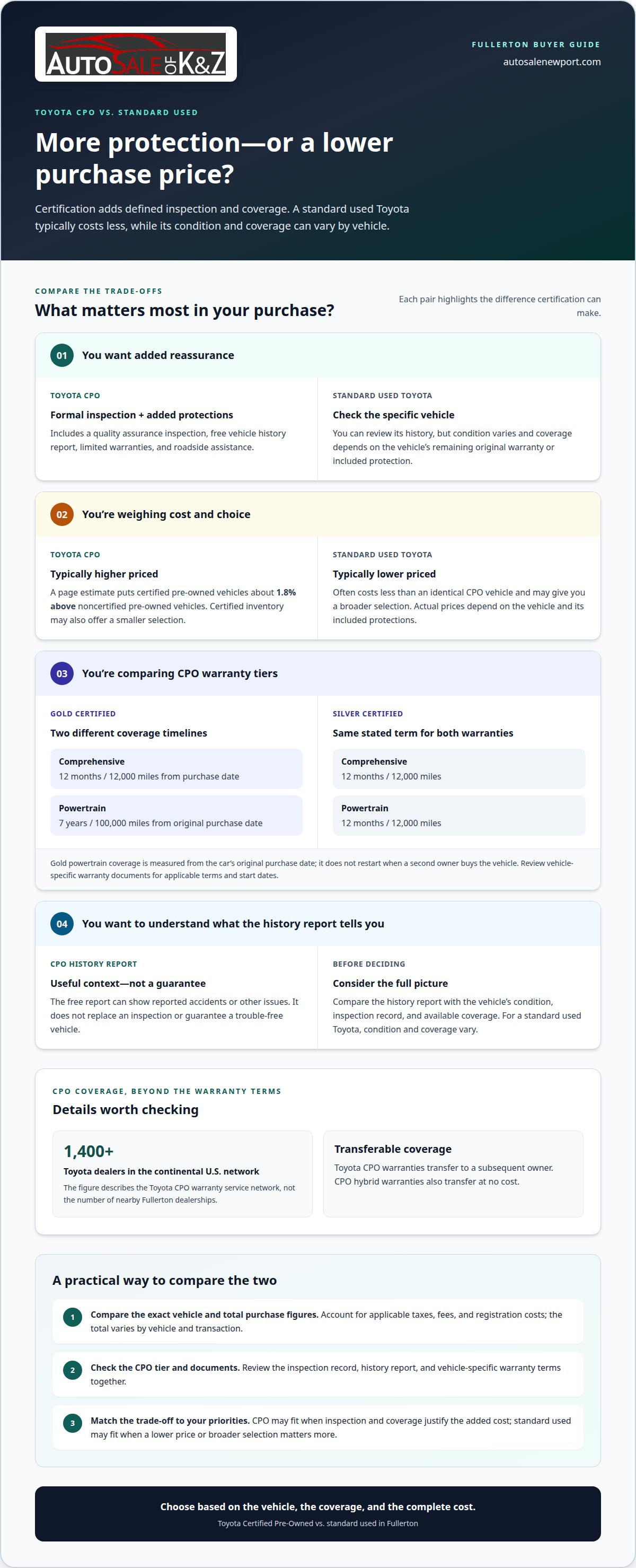
Costs also shape the choice. A page estimate puts certified pre-owned vehicles about 1.8% above noncertified pre-owned vehicles, while standard used vehicles are typically priced lower than identical CPO listings. Actual vehicle selection matters: age, condition, model, and included protections can affect whether a certification premium makes sense. A smaller selection of certified vehicles may also narrow the models or features available at a given time.
For a used-car purchase in Fullerton, account for the vehicle price and applicable taxes, fees, and registration costs. The total varies by vehicle and transaction, so compare the complete purchase figures, not just the listing price.
Toyota dealerships sell certified pre-owned vehicles, but available models and inventory change. The Toyota CPO warranty network includes more than 1,400 dealers across the continental United States, although that figure describes warranty service coverage, not the number of nearby Fullerton dealerships.
| Option | Price | Inspection and history | Coverage | Best fit |
|---|---|---|---|---|
| Toyota CPO | Typically higher than an identical used listing | Quality assurance inspection and free history report | Limited warranties and roadside assistance | Buyers who value added protections |
| Standard used Toyota | Typically lower than an identical CPO vehicle | Vehicle history can be reviewed; condition varies | Coverage varies by vehicle | Buyers prioritizing a lower purchase price or broader selection |
Choose CPO if its inspection and coverage justify the added cost for your priorities. Choose standard used if price and vehicle selection matter more.
Certified Pre-Owned Toyota vs Used Toyota: What’s the Difference?
Toyota CPO adds defined warranty coverage to a qualifying pre-owned vehicle. Compare when that coverage starts, what it protects, and whether any original warranty remains.
Toyota CPO Warranty Coverage
Gold Certified Toyotas include a 12-month/12,000-mile limited comprehensive warranty starting on the purchase date. They also have a seven-year/100,000-mile limited powertrain warranty, measured from the car’s original purchase date. Silver Certified vehicles include a 12-month/12,000-mile limited comprehensive warranty and a 12-month/12,000-mile limited powertrain warranty.
Used-Car Warranties and Potential Issues
A standard used Toyota does not automatically include the same CPO warranty package. Any remaining coverage depends on the vehicle’s original warranty status, and buyers may seek additional protection. Toyota CPO coverage protects against mechanical failures and defects, subject to the listed terms. Compare the exact terms for a powertrain issue with those for a covered comprehensive repair.
Remaining Original Warranty Coverage
A CPO Toyota may retain its original limited powertrain warranty, described as seven years and 100,000 miles. Because that period starts on the original purchase date, it doesn’t restart when the second owner buys the vehicle. Compare the original coverage timeline with the CPO warranty’s purchase-date start, so the two protections aren’t mistaken for one continuous new warranty.
Toyota Certified Used Vehicles includes a quality assurance inspection, limited comprehensive and powertrain warranties, roadside assistance, and a free vehicle history report. To verify a vehicle’s inspection, history, and warranty, review its inspection record, history report, and vehicle-specific warranty documents together. These documents clarify the coverage level and applicable start dates.
Coverage for a standard used car varies according to its remaining original warranty and any additional protection included. Toyota CPO warranties, by contrast, transfer to a subsequent owner. CPO hybrid warranties also transfer at no cost, an important distinction if you are considering a pre-owned Toyota hybrid.
The warranty protection travels with the vehicle, rather than staying limited to the selling dealership. Coverage is honored at more than 1,400 Toyota dealers across the continental service network. That broad network can matter to an owner who travels or moves, while a standard used vehicle’s coverage depends on its own warranty terms.
Toyota certified pre-owned eligibility and inspection
Toyota certification depends on the vehicle meeting a program tier’s standards and passing its required inspection. Gold and Silver have different inspection counts, so the label identifies more than a seller’s description. Model year, condition, and mileage also help buyers understand the specific vehicle and its remaining coverage.
For Gold Certified status, a Toyota must be less than six years old and pass a 160-point inspection. The age rule is a threshold: a vehicle that reaches six years doesn’t meet this stated Gold age requirement. Passing the inspection is also essential; model age alone does not establish certification.
Silver Certified status requires passing a 136-point inspection. The available criteria distinguish Silver from Gold by the inspection count, while the Gold age requirement applies specifically to Gold status. For example, a Toyota that doesn’t fit Gold’s age threshold may still be evaluated for another certification tier, provided it meets that tier’s requirements.
Mileage offers useful context, but it is not the same as the stated Gold age rule or inspection count. The odometer reading shows how far a vehicle has travelled and can help indicate how much mileage may remain under mileage-limited coverage. Compare mileage with model year, condition, and warranty terms instead of treating it as a substitute for an inspection.
The inspection includes specific condition requirements. Toyota CPO vehicles must have four tires of the same brand, model, and size, with safe tread depth. This shows how certification assesses a vehicle beyond its age. Tire consistency and safe tread are inspection requirements, not just cosmetic preferences.
Use these distinctions to read a certification label accurately:
- Gold: Less than six years old and passes a 160-point inspection.
- Silver: Passes a 136-point inspection.
- Both tiers: Certification depends on meeting the applicable inspection requirements.
- Tires: Four matching tires must meet the stated brand, model, size, and tread conditions.
Toyota CPO hybrids have a separate 174-point inspection. That figure applies to hybrids, so buyers comparing hybrid models should distinguish this inspection count from the 160-point Gold and 136-point Silver counts. Certification level, model year, odometer reading, and inspection results together provide a clearer picture than any single detail.
As you compare Toyota models, review each vehicle’s certification tier and inspection result alongside its age and mileage. This helps distinguish the program’s eligibility standards from the details that shape a vehicle’s condition and remaining coverage.
Toyota CPO inspection and reconditioning
Toyota CPO status requires a formal, Toyota-backed quality assurance inspection. The inspection checks specified categories and components, while reconditioning addresses findings that need attention before a vehicle meets program standards. These steps serve different purposes: inspection evaluates the vehicle, and reconditioning addresses identified issues.
The inspection scope depends on the vehicle’s certification category. Toyota CPO vehicles undergo an inspection covering between 136 and 160 categories and components. Toyota CPO hybrids undergo a 174-point inspection. Those figures show why the model type matters: a hybrid’s inspection count differs from the range used for other CPO vehicles.
For buyers, the value lies in the documented process, not in assuming every Toyota receives identical work. A technician evaluates the vehicle against applicable inspection requirements. If an issue affects qualification, the vehicle must meet the program standard to pass. The inspection count describes the scope; it does not mean every component needs reconditioning.
Reconditioning depends on the inspection findings. The work required can vary between Toyota models because their condition and identified needs differ. One vehicle, for example, may need no work in a particular area, while another may need attention to meet the standard. Together, the inspection result and completed work explain how a CPO vehicle was prepared.
A standard used Toyota does not become Toyota CPO simply because it looks clean or drives well. A certified technician’s inspection is a useful first step when evaluating a used vehicle. It adds information about condition, while Toyota’s formal CPO process connects inspection results with certification eligibility.
- Inspection: Evaluates the vehicle against Toyota’s quality assurance requirements.
- Reconditioning: Addresses findings that need attention for the vehicle to meet the applicable standard.
- Certification: Follows after the vehicle satisfies its program requirements.
These steps also explain what CPO status adds. Certification indicates that a formal Toyota-backed inspection took place, while a standard used vehicle’s condition depends on its history and evaluation. Neither label tells you everything about the vehicle’s current condition, so review the inspection record to understand what was assessed.
When comparing vehicles, connect the inspection result to the specific car rather than comparing labels alone. A Toyota hybrid, for example, has a different stated inspection count from the general CPO range. Matching the model type, inspection scope, and reconditioning record makes the decision more specific and easier to assess.
Shared benefits of certified and standard pre-owned Toyotas
Certification changes the inspection and coverage, but both options share an important advantage: you are buying a pre-owned Toyota rather than a new vehicle. Pre-owned Toyota vehicles are less susceptible to rapid depreciation during the first few years of private ownership than new vehicles. This can matter if you plan to own the car through those early years and want to weigh its purchase price against expected ownership costs.
Both choices also let you consider Toyota models across different vehicle types and price points. A Prius hybrid, Corolla sedan, Camry sedan, and RAV4 SUV serve different driving needs. A certification label doesn’t change those basic differences. Start with the vehicle size and use that suit your routine, then compare certified and standard used examples within that category.
Both options also let you assess a vehicle’s history and condition before buying. A history report can show reported accidents or other issues, while an inspection offers a closer look at the vehicle itself. These steps are useful for certified and standard used Toyotas alike. For example, compare two similar Corolla models by reviewing their history, condition, mileage, and included coverage, not just their labels.
Financing is another factor, although it may not favor both categories equally. Used cars often have higher interest rates on average than certified pre-owned cars or new vehicles. The purchase price alone therefore does not show the full financing picture. Consider how the rate and loan terms affect the total amount you will repay, alongside the protections included with a CPO Toyota.
Both certified and standard pre-owned vehicles can offer a practical route to Toyota ownership without choosing a new car. A new car can lose 20% of its value on its first drive home from the dealership. That figure doesn’t determine the value of a particular used Toyota, but it illustrates why some shoppers compare pre-owned options before deciding.
To assess the benefits clearly, separate what both options share from what comes specifically with certification. Both types can offer:
- A pre-owned Toyota that fits your preferred model and daily needs.
- The chance to review a vehicle history report and condition.
- A way to compare purchase and financing terms before choosing.
- Less exposure to the rapid depreciation associated with a new vehicle’s early ownership years.
The clearest approach is to choose the model first, compare the individual vehicles, then decide whether CPO coverage justifies its added cost. If financing is part of your decision, review available financing options as you compare the full purchase terms.
Auto Sale Newport
Auto Sale Newport can help you move from comparing certification benefits to considering a pre-owned Toyota that fits your needs. If you’re weighing a Prius, Corolla, Camry, or RAV4, focus on the vehicle’s condition, history, and any warranty coverage alongside its model and features. Those details help you assess the individual car, rather than relying on the certified or used label alone.
Bring your priorities to the decision: the protections you value, the model that suits your routine, and the vehicle details that matter most. Auto Sale Newport offers pre-owned Toyota options to help you compare vehicles in a practical way.
For help comparing pre-owned Toyota options, contact Auto Sale Newport.
Choose the Toyota That Fits Your Next Step
When comparing Toyota certified pre-owned versus used options in Fullerton, let your priorities guide the decision. Choose a vehicle that suits your routine, then compare its condition, history, and coverage with the protections you value. A clear match matters more than choosing a label by default.
Auto Sale Newport offers pre-owned vehicles including the Toyota Prius, Tesla Model 3, and Tesla Model Y. Consider which model aligns with your needs, then bring your preferred option and priorities into the conversation. A focused discussion can help you move from research toward a decision that feels right for you.
Contact Auto Sale Newport today to discuss your next vehicle. Take the next step at your own pace, with a clearer sense of what matters most.
Frequently Asked Questions
Used vs CPO Toyota: Which Should You Choose?
Choose a CPO Toyota if its inspection and warranty protections are worth more to you than the typically lower purchase price of a standard used vehicle. A standard used Toyota may suit you if a particular vehicle meets your needs and budget. If you are comparing Toyota certified pre-owned vs. used in Fullerton, weigh each car’s condition, history, coverage, and total purchase terms rather than relying on the label alone.
Does Certified Pre-Owned Mean Lower Ongoing Costs?
No. Certification does not guarantee lower ongoing costs. CPO warranty coverage may help with repairs to covered components during its term, but it does not determine the full cost of owning a particular vehicle. Toyotas with different mileage or condition may have different needs. Compare the specific coverage with the vehicle’s condition and your ownership plans instead of assuming certification reduces every future expense.
Does certification affect resale value later?
Certification does not guarantee a higher resale price. A transferable Toyota CPO warranty may matter to a future buyer if coverage remains, but condition, mileage, history, and market demand also influence resale. Keep the warranty and vehicle records together to document the car’s history if you sell. Treat potential resale appeal as one factor, not a promised return.
Does the certification tier affect financing options?
A certification tier does not guarantee a particular financing rate or loan term. Used cars often have higher interest rates on average than CPO or new vehicles, while lenders consider the overall application and vehicle. Compare the complete financing terms for each car, including its rate and repayment schedule. This gives you a better basis for weighing purchase terms against certification protections.
How Should You Decide Between Used, Certified, Or New?
Start with the vehicle and ownership plan that suit your needs, then compare used and CPO options by condition, history, coverage, and purchase terms. For a Toyota certified pre-owned vs. used decision in Fullerton, decide whether CPO protections justify the difference between the specific vehicles you are considering. Treat a new vehicle as a separate option, weighing its purchase terms and early depreciation against pre-owned choices.
How can a shopper tell which tier a specific car falls under?
Review the Toyota certification documents to see whether they identify Gold Certified or Silver Certified status. Match the stated tier with the inspection record and warranty paperwork. A sales description alone does not explain the exact coverage. Because Gold and Silver have different inspection counts, the vehicle’s documents show which program requirements and protections apply.
What are Toyota certified pre-owned requirements for age, mileage, and condition?
Gold Certified Toyotas must be less than six years old and pass a 160-point inspection; Silver Certified vehicles must pass a 136-point inspection. Toyota CPO vehicles also need four tires matching in brand, model, and size, with safe tread depth. Mileage helps explain mileage-limited coverage, but isn’t a substitute for the listed age and inspection requirements. Review the vehicle’s documents for its terms.
What warranty and roadside assistance come with a Toyota certified pre-owned vehicle?
Toyota CPO vehicles include roadside assistance and limited warranty coverage, with terms that depend on certification level. Gold includes a 12-month/12,000-mile limited comprehensive warranty from purchase and a seven-year/100,000-mile limited powertrain warranty from the original purchase date. Silver includes 12-month/12,000-mile limited comprehensive and powertrain warranties. Review the specific vehicle’s paperwork for coverage dates, mileage limits, and roadside assistance terms.


