

In a Toyota Camry vs Honda Accord used reliability comparison, the better choice often depends less on the badge and more on the individual car’s maintenance history and condition. Both sedans have strong reputations, but a well-cared-for Accord may be a better bet than a neglected Camry, and the reverse is just as true.
It’s understandable to look for a clear winner. Reliability ratings and owner opinions can help narrow your options, but they can’t tell you how a specific car was driven, maintained, or repaired. Model year, generation, engine, and trim also shape what to compare, so broad online rankings are only one part of the decision.
This guide explains how to compare Camrys and Accords fairly across model years, review maintenance and repair records, and check for open recalls. You’ll also learn what to look for during an inspection and test drive. A consistent checklist helps you judge the car in front of you and choose the used sedan that best fits your driving needs and ownership priorities.
Key Takeaways
- Compare Camry and Accord examples from similar model years and configurations for a fairer assessment.
- Use a Toyota Camry vs Honda Accord used reliability comparison to guide research, not to assume one badge guarantees a dependable car.
- Review maintenance and vehicle-history records, title status, and open recalls before deciding.
- Let the specific car’s condition and your driving priorities guide your choice between the two sedans.
- Shortlist comparable vehicles and assess each one with the same buying checklist.
Toyota Camry vs. Honda Accord Used Reliability: What Does Reliability Really Mean?
Is a used Toyota Camry or Honda Accord likely to be a dependable choice? Both have established reputations, but a model’s reputation can’t tell you whether an individual car has been maintained well or developed problems. For a buyer, reliability means considering durability over time, maintenance and repair history, and the vehicle’s current condition.
That distinction matters in a Toyota Camry vs Honda Accord used reliability comparison. A car with consistent service records and signs of careful ownership may be a stronger candidate than a similar model with gaps in its history. Mileage matters, too, but it’s most useful alongside maintenance records, how the car was used, and its present condition.
For a visual overview of the comparison, watch this video:
How should buyers compare used-car reliability?
Separate the models’ long-term reputations from the condition of the two specific cars you’re considering. Reliability rankings can offer context, but they don’t guarantee how a particular vehicle will perform. Assess the evidence together: maintenance documentation, vehicle-history information, recall status, and inspection findings. If records are incomplete or the car’s condition raises questions, don’t let a strong brand reputation outweigh what you can verify.
Why model year and configuration matter
Compare cars from similar model years and, where possible, equivalent powertrain categories. A gas model and a hybrid, or two cars with different equipment, may not be a like-for-like comparison. Year, trim, mileage, and ownership history can all affect what you need to review.
Redesigns and equipment changes can also make adjacent model years meaningfully different. Before relying on a claim about a known issue or technical feature, verify that it applies to the exact year and configuration. This history of Toyota Camry model generations can help you understand how the model changed over time. Apply the same year-by-year care to the Accord, then check the specific car’s records and recall information instead of assuming every vehicle in a generation has the same history.
Camry vs. Accord Reliability by Model Year, Maintenance, and Mileage
A fair Toyota Camry vs Honda Accord used reliability comparison starts with the specific vehicles, not a blanket verdict about either nameplate. Compare similar model years and powertrain types, then weigh records, mileage, recall status, and present condition together. A vehicle’s documented condition can’t be established by its make alone.
| Factor | What to compare |
|---|---|
| Model year | Match years where possible, and verify specifications and known issues for each exact year and configuration. |
| Maintenance records | Look for dated, consistent service history and compare it with the manufacturer’s schedule for that vehicle. |
| Mileage | Consider the odometer reading alongside service documentation, ownership pattern, and current condition. |
| Recalls | Check each vehicle’s VIN for open recalls and review whether any applicable recall work was completed. |
| Condition | Use an inspection and test drive to assess how the individual car operates, not just how its records read. |
What maintenance records can reveal
Service records provide a timeline of care. Look for dated entries showing regular maintenance and follow-up on issues, then compare the work with the schedule for that exact model year. Consistent documentation can strengthen confidence in either sedan, but a missing entry doesn’t automatically mean the car was neglected. Treat gaps as uncertainty and look for other evidence before drawing a conclusion.
Recall status is separate from routine servicing. Use the National Highway Traffic Safety Administration’s VIN lookup to Check for Recalls on a Used Camry or Accord. A recall listing doesn’t establish the condition of a specific vehicle, so review the VIN-specific result and available repair documentation.
How mileage and vehicle history affect the comparison
Mileage is useful, but it doesn’t tell the whole story. A higher-mileage car with clear service documentation may deserve closer consideration than a lower-mileage example with an unexplained history. Review an appropriate vehicle-history report for title, accident, and ownership information, then compare it with the seller’s records and the car’s condition.
Verify claims about common problems against credible sources that cover the exact model year and configuration. If you’re building a shortlist, browse used Toyota Camrys and apply the same comparison criteria to each candidate.
Which Used Sedan Is the Better Fit? Compare Camry and Accord Trade-Offs
There’s no reliable shortcut from model name to the right choice. First compare each car’s records, history, and present condition. If the evidence is similar, use your priorities to decide: cabin comfort, daily driving, specific equipment, and how well the vehicle’s ownership history is documented. In a Toyota Camry vs Honda Accord used reliability comparison, brand reputation can help break a close tie, but it shouldn’t outweigh the facts about the individual car.
| Factor | What you can assess | Buyer priority or item to verify |
|---|---|---|
| Records and condition | Available service documents, vehicle history, and inspection findings | Favor the car with clearer documentation and condition that fits your expectations |
| Cabin comfort | Seat support, visibility, passenger space, and ease of entry | Compare both cars in person and on a test drive, using your usual passengers and routine |
| Daily driving | How each car feels on the types of roads you regularly use | Consider commuting, parking, longer trips, and the driving feel you prefer |
| Equipment | Features fitted to the specific vehicle | Verify trim and equipment for the exact model year rather than assuming features carry across versions |
When a Camry may suit a used-car shopper
A Camry may be a good fit if a particular example meets your needs for comfort, equipment, and everyday use, and its history and condition support your confidence in it. Check its model year, configuration, service records, and inspection findings rather than assuming every Camry has the same reliability or ownership costs. For more ways to structure a local used-car search, see Best Used Cars for Sale in Fullerton, CA: 2026 Buyer’s Guide.
When an Accord may suit a used-car shopper
Use the same checklist for an Accord. Review its documentation and condition, then sit in it and take a test drive to see whether its cabin, equipment, and driving experience suit your routine. Verify model-year-specific features and any performance or reliability claims against credible information for the exact configuration. This keeps the comparison fair without assuming every Accord shares the same strengths or history.
Once you’ve compared the evidence, decide which vehicle better matches your priorities. If the records or condition clearly favor one, that may matter more than a small difference in reputation. If both look similarly sound, comfort, equipment, and everyday fit can help you make the call.
How to Check a Used Camry or Accord Before You Buy
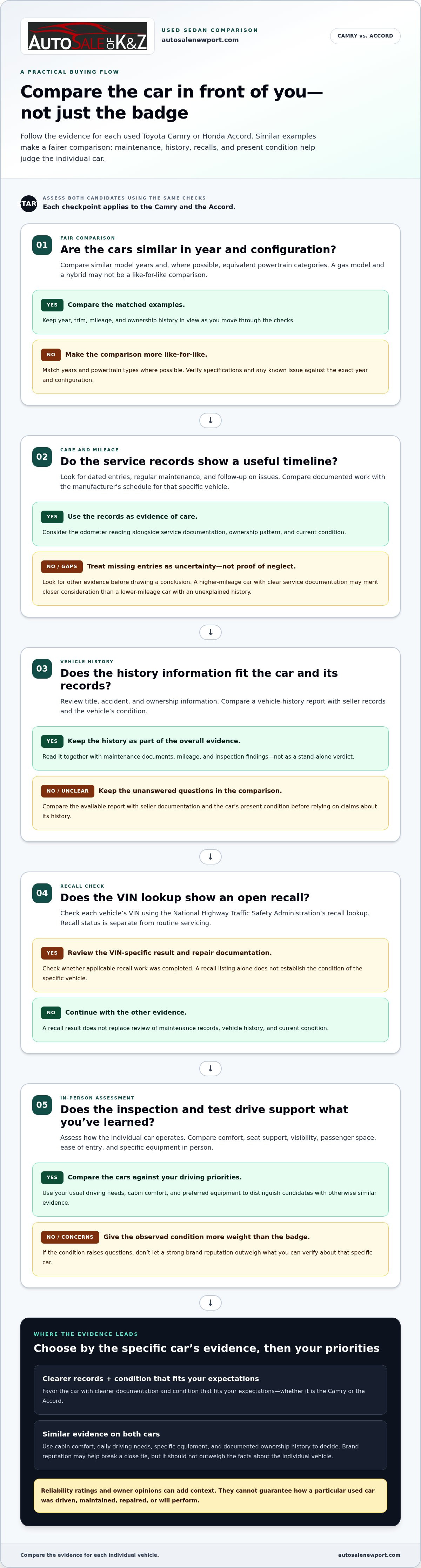
A practical inspection turns the Toyota Camry vs Honda Accord used reliability question into a vehicle-by-vehicle decision. Use the same checklist for either sedan and keep notes, so you can compare findings rather than rely on memory or a quick impression.
A practical pre-purchase checklist for both models
- 1. Match the vehicle details. Check that the VIN on the car matches the title and available history documents. Confirm the model year and configuration before reviewing maintenance schedules or model-specific information.
- 2. Review the history and title. Read a vehicle-history report for title, accident, and ownership information. Compare its details with the documents available for the car, and note anything that needs clarification.
- 3. Check service records. Look for dated records that show consistent care. Compare documented work with the manufacturer’s maintenance schedule for the exact model year. Missing paperwork is uncertainty, not proof of a problem.
- 4. Check recall status. Search the VIN using the National Highway Traffic Safety Administration’s recall lookup, and review whether any applicable recall work is documented as complete.
- 5. Inspect the car inside and out. Look at tire wear, visible brake condition, exterior panels, and interior wear. Turn the car on and note dashboard warning lights. Test basic functions, including lights, windows, and air conditioning.
- 6. Take a careful test drive. If practical, drive on different types of roads. Pay attention to steering, braking, transmission behavior, unusual sounds, and how the car responds. Note any drivability concerns for follow-up.
What to review on a test drive in Fullerton
Local driving conditions can help you assess whether a car suits your routine. Southern California heat and stop-and-go use are useful context when thinking about how a vehicle may have been driven, but they don’t prove damage or neglect. Let the records and the car’s condition provide the evidence.
If the vehicle has been sitting in the local climate, check that the cabin feels comfortable and that the air conditioning operates as expected. A short drive can reveal concerns, but it can’t replace reviewing records, title information, recall status, and overall condition.
Auto Sale Newport’s Fullerton showroom offers test drives, and the online inventory makes it easy to review vehicles before a visit. Browse current used-car inventory or arrange a test drive to assess a specific vehicle in person.
Choose Your Used Camry or Accord with a Clearer Buying Plan
A sound choice comes from comparing individual vehicles, not choosing a badge in advance. Shortlist Camrys and Accords from similar years and comparable configurations, then assess each one using the same standards. That keeps the Toyota Camry vs Honda Accord used reliability decision focused on evidence and on what matters to you.
A simple decision framework for the final comparison
Use this order to keep the process manageable:
- Set aside vehicles with unresolved concerns. Gaps or conflicts in documentation, troubling history details, or condition issues deserve attention before you weigh comfort or equipment.
- Compare the strongest candidates. Look at maintenance evidence, title and vehicle history, inspection findings, and recall status. Then consider equipment, cabin comfort, and how each car fits your intended use.
- Choose the better individual vehicle. If one has clearer records and a condition that better meets your needs, that may outweigh a general reputation advantage. If the evidence is comparable, let your priorities guide the decision.
Explore used cars in Fullerton
For another perspective on comparing local options, read Finding the Best Used Car Deals in Fullerton: A 2026 Guide to Affordable Dealerships. Auto Sale Newport offers pre-owned Toyota Camrys, and you can browse inventory online before visiting the Fullerton showroom to compare vehicles and take a test drive. For shoppers comparing used sedans around Fullerton and across Orange County, including Anaheim, Buena Park, Santa Ana, and Orange, the same checklist also applies to listings in Los Angeles, Long Beach, Riverside, Corona, San Bernardino, San Diego, and Bakersfield.
Financing options, trade-in valuations, and on-site appraisals can also help you plan a purchase or sale. They’re separate from assessing reliability and vehicle condition, but can be useful parts of the overall decision.
Use your shortlist and the same inspection criteria to compare each vehicle, without assuming either sedan is the automatic winner.
Make Your Next Used-Sedan Choice with Confidence
The Toyota Camry vs Honda Accord used reliability comparison comes down to more than brand reputation. Compare similar years and configurations, review maintenance and vehicle-history records, check recall status, and judge each car’s current condition. Then weigh comfort, equipment, and everyday needs to choose the stronger individual fit.
Auto Sale Newport offers pre-owned Toyota Camrys, with online inventory browsing and showroom test drives in Fullerton. Trade-in valuations, financing options, and on-site appraisals can also support your buying plans. Explore available vehicles and take your time evaluating which one fits your needs.
Browse Auto Sale Newport’s pre-owned inventory and plan a test drive. A clear checklist and careful comparison can help you move ahead feeling prepared and confident.
Frequently Asked Questions
Is a used Toyota Camry more reliable than a used Honda Accord?
Neither model is automatically more reliable in every year or as an individual used car. For a fair Toyota Camry vs Honda Accord used reliability comparison, match similar years and configurations, then review service records, vehicle history, open recalls, and condition. A well-documented, carefully maintained example of either sedan may be a stronger choice than a neglected one. Treat reliability rankings as broad context, and verify that they apply to the model year you’re considering.
Which model years of the Camry and Accord should I avoid?
There isn’t a responsible blanket list of Camry or Accord years to avoid without credible, model-specific evidence. Each sedan has changed across generations, and a reported concern may apply only to certain years, powertrains, or equipment. Check recall information and trusted reliability sources for the exact configuration you’re considering, then review that car’s records and history. Online owner accounts can point you toward questions to investigate, but they don’t prove every vehicle from that year has the same issue.
Can a high-mileage Camry or Accord still be reliable?
Yes, a high-mileage Camry or Accord can still be a reasonable choice, but the odometer alone can’t establish its condition or future dependability. Review maintenance records and ownership and accident history, then inspect tires, brakes, and overall condition. During a test drive, pay attention to unusual sounds and how the car responds. Compare documented maintenance with the schedule for that specific year. Missing records create uncertainty, while low mileage by itself isn’t a guarantee of reliability.
What should I check before buying a used Camry or Accord?
Start by matching the VIN and model year on the vehicle with the title and available history documents. Review service records and vehicle history, check the VIN for open recalls, and inspect the car’s overall condition. On a test drive, note steering and braking behavior, warning lights, unusual sounds, and whether basic features work. Use these findings alongside your needs and the vehicle’s documented maintenance. The same checklist applies to both models.
Are Toyota Camry and Honda Accord repairs expensive?
Repair expenses vary with the model year, powertrain, condition, parts, and the specific work needed, so neither sedan is always cheaper to repair. For a particular car, examine its service history and investigate any reported concern using credible information for that year and configuration. If you compare repair-cost estimates, check that the source explains what’s included and how the figures were gathered. A general average can’t predict the cost of a future repair on one vehicle.
Should I choose a Camry or Accord based on reliability ratings?
Use reliability ratings as one research tool, not as the only reason to choose a car. Confirm that a rating covers the model year and configuration you’re considering, and understand what the source measures. Then weigh it against the vehicle’s own records, history, recall status, and current condition. A ranking describes a group of cars; it can’t guarantee how one used sedan will perform or how well it fits your driving needs.
Does Southern California driving affect a used sedan’s reliability?
Southern California heat and stop-and-go traffic can provide useful context about a car’s use, but they don’t prove damage or neglect. Review available records and inspect the vehicle rather than drawing conclusions from where it was driven. For a car you’re considering in Fullerton or elsewhere in Orange County, check air-conditioning performance, visible wear, and how it behaves during a test drive. Apply the same evaluation to both the Camry and Accord.


